候 (hòu) means "wait / time / season" in Chinese. It has 10 strokes with the radical 亻, and is HSK Level 1.
Rated 3.4/5 in difficulty (challenging).
Harder than 71% of HSK Level 1 characters.
Appears in 3+ common words including 时候 (shí hòu), 等候 (děng hòu), 问候 (wèn hòu).
Due to its 10 strokes, Hanzi Writer's error detection shows 候 requires focused practice — most learners need 10+ attempts for consistent accuracy.
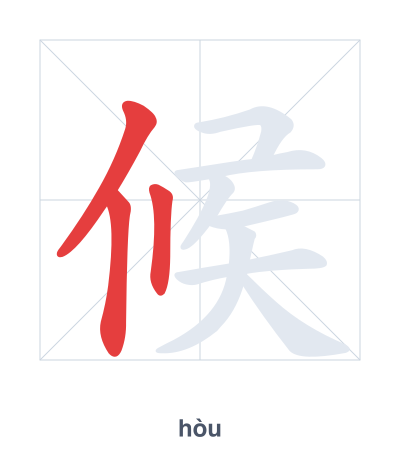
Open Hanzi Writer to see the animated stroke order and practice writing 候 with real-time feedback.
The character 候 (hòu) is written with 10 strokes. Follow the standard Chinese stroke order: top to bottom, left to right, outside before inside. The radical 亻 is one of its key components.
Practice the correct stroke order with the Hanzi Writer app to see animated stroke-by-stroke guidance with real-time feedback.
候 means wait / time / season.
As an HSK Level 1 character, 候 is among the first characters beginners learn.
候 combines the radical 亻 (person) with 侯, which originally depicted a target (made of hide) for archery. The person watching the target implies waiting for the right moment, giving the meanings 'wait', 'time', and 'season'.
💡 Memory Tip: Picture a person (亻) standing with a bow, arrow (矢) aimed at a cliff (厂), patiently waiting for the perfect time to shoot.
你什么时候回来?
nǐ shén me shí hòu huí lái
When are you coming back?
请在门口等候。
qǐng zài mén kǒu děng hòu
Please wait at the door.
向你的家人问候。
xiàng nǐ de jiā rén wèn hòu
Give my regards to your family.
Open Hanzi Writer to see the animated stroke order and practice writing 候 with real-time feedback.
✨ Animated stroke order · Handwriting recognition · HSK-graded practice · Free to use
候 is made of the radical 亻 (person) on the left and 侯 (hóu) on the right. The person radical shows that the meaning involves people, while 侯 originally meant 'target' or 'wait for an opportunity,' together suggesting a person waiting for a specific time or season.