房 (fáng) means "house; room" in Chinese. It has 8 strokes with the radical 户, and is HSK Level 1.
Rated 3.2/5 in difficulty (challenging).
Harder than 65% of HSK Level 1 characters.
Appears in 3+ common words including 房子 (fáng zi), 房间 (fáng jiān), 房东 (fáng dōng).
Due to its 8 strokes, Hanzi Writer's error detection shows 房 requires focused practice — most learners need 10+ attempts for consistent accuracy.
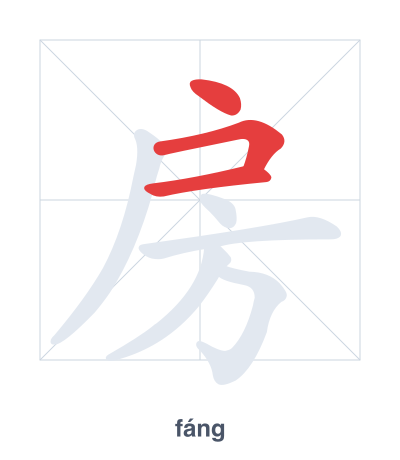
Open Hanzi Writer to see the animated stroke order and practice writing 房 with real-time feedback.
The character 房 (fáng) is written with 8 strokes. Follow the standard Chinese stroke order: top to bottom, left to right, outside before inside. The radical 户 is one of its key components.
Practice the correct stroke order with the Hanzi Writer app to see animated stroke-by-stroke guidance with real-time feedback.
房 means house; room.
As an HSK Level 1 character, 房 is among the first characters beginners learn.
房 combines the radical 户 (door) with 方 (side/direction). The original meaning was a side room or chamber with a door on the side, as ancient Chinese homes often had rooms arranged around a courtyard.
💡 Memory Tip: A door (户) opens to a square (方) room—that's your house.
这套房子很大。
zhè tào fáng zi hěn dà
This house is very big.
我的房间很干净。
wǒ de fáng jiān hěn gān jìng
My room is very clean.
房东人很好。
fáng dōng rén hěn hǎo
The landlord is a very nice person.
Open Hanzi Writer to see the animated stroke order and practice writing 房 with real-time feedback.
✨ Animated stroke order · Handwriting recognition · HSK-graded practice · Free to use
房 is composed of the radical 户 (household/door) on the left and 方 (square/direction) on the right. The 户 radical suggests a building or entrance, while 方 provides a phonetic hint and also visually represents a square structure, together meaning 'house' or 'room'.