蜜 (mì) means "honey" in Chinese. It has 14 strokes with the radical 虫, and is HSK Level 7.
Rated 4.2/5 in difficulty (advanced).
Harder than 88% of HSK Level 7 characters.
Appears in 3+ common words including 蜂蜜 (fēng mì), 甜蜜 (tián mì), 蜜蜂 (mì fēng).
Due to its 14 strokes, Hanzi Writer's error detection shows 蜜 requires focused practice — most learners need 10+ attempts for consistent accuracy.
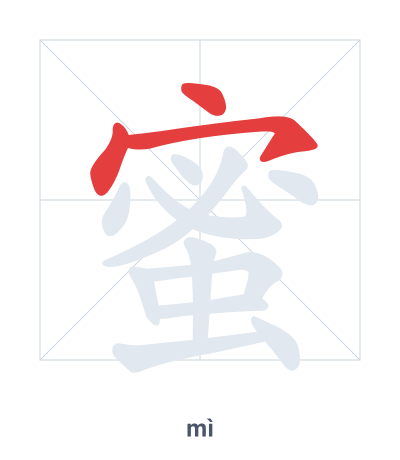
Open Hanzi Writer to see the animated stroke order and practice writing 蜜 with real-time feedback.
The character 蜜 (mì) is written with 14 strokes. Follow the standard Chinese stroke order: top to bottom, left to right, outside before inside. The radical 虫 is one of its key components.
Practice the correct stroke order with the Hanzi Writer app to see animated stroke-by-stroke guidance with real-time feedback.
蜜 means honey.
As an HSK Level 7 character, 蜜 is an intermediate-level character.
蜜 is a phono-semantic compound: the top part 宓 (mì) provides the sound, while the bottom radical 虫 (chóng, insect) indicates that honey is produced by bees. Together, the character visually represents the connection between the insect and the sweet substance it creates.
💡 Memory Tip: Picture a busy bee (虫) flying into a honey jar shaped like the top part 宓, storing sweet honey inside.
蜂蜜的味道很甜。
fēng mì de wèi dào hěn tián
Honey tastes very sweet.
他们的生活很甜蜜。
tā men de shēng huó hěn tián mì
Their life is very sweet.
蜜蜂在花丛中飞。
mì fēng zài huā cóng zhōng fēi
Bees are flying among the flowers.
Open Hanzi Writer to see the animated stroke order and practice writing 蜜 with real-time feedback.
✨ Animated stroke order · Handwriting recognition · HSK-graded practice · Free to use
蜜 is made of three parts: the roof radical 宀 on top, 必 in the middle, and 虫 (insect) at the bottom. The insect 虫 represents bees, which produce honey, and the roof 宀 suggests a hive or a container where honey is kept. The 必 part may originally hint at the sound, but together they create the idea of something sweet from insects.