回 (huí) means "To return; to go back; time/occurrence." in Chinese. It has 6 strokes with the radical 囗, and is HSK Level 1.
Rated 2.7/5 in difficulty (moderate).
Harder than 41% of HSK Level 1 characters.
Appears in 3+ common words including 回家 (huí jiā), 回答 (huí dá), 回来 (huí lái).
Hanzi Writer's stroke validation shows learners typically need 5-8 attempts to write 回 with correct proportion and order.
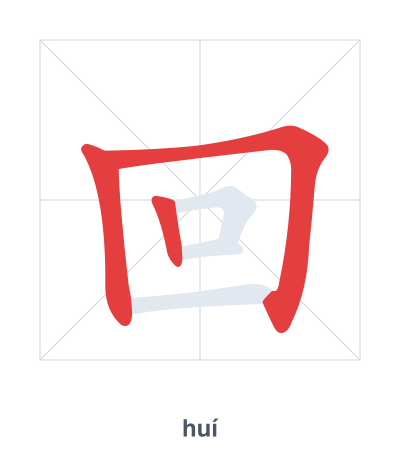
Open Hanzi Writer to see the animated stroke order and practice writing 回 with real-time feedback.
The character 回 (huí) is written with 6 strokes. Follow the standard Chinese stroke order: top to bottom, left to right, outside before inside. The radical 囗 is one of its key components.
Practice the correct stroke order with the Hanzi Writer app to see animated stroke-by-stroke guidance with real-time feedback.
回 means To return; to go back; time/occurrence..
As an HSK Level 1 character, 回 is among the first characters beginners learn.
回 started as a pictograph of a whirlpool or spiral, depicting circular motion. The modern form shows an outer enclosure (囗) containing a smaller square, visually representing something that moves in a loop and returns to its starting point.
💡 Memory Tip: Picture a square path (囗) with a smaller square inside that you walk around until you come right back to where you began.
我想回家。
wǒ xiǎng huí jiā
I want to go home.
请回答我的问题。
qǐng huí dá wǒ de wèn tí
Please answer my question.
他什么时候回来?
tā shén me shí hòu huí lái
When will he come back?
Open Hanzi Writer to see the animated stroke order and practice writing 回 with real-time feedback.
✨ Animated stroke order · Handwriting recognition · HSK-graded practice · Free to use
回 is made of an outer square (the radical 囗, meaning enclosure) and an inner square (口, meaning mouth or opening). The image of a square inside a square suggests something going around and coming back, like a path that returns to its start. This structure directly connects to its meanings of 'to return' or 'to go back.'