算 (suàn) means "to calculate / to count" in Chinese. It has 14 strokes with the radical ⺮, and is HSK Level 2.
Rated 3.7/5 in difficulty (challenging).
Harder than 90% of HSK Level 2 characters.
Appears in 3+ common words including 打算 (dǎ suàn), 算了 (suàn le), 计算 (jì suàn).
Due to its 14 strokes, Hanzi Writer's error detection shows 算 requires focused practice — most learners need 10+ attempts for consistent accuracy.
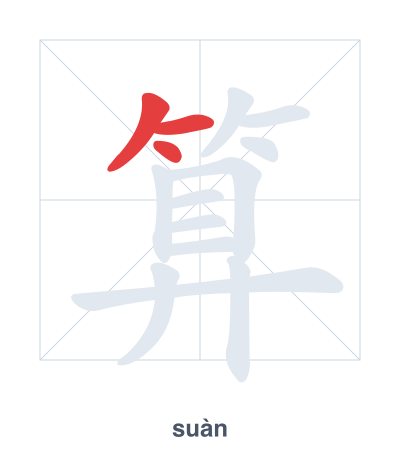
Open Hanzi Writer to see the animated stroke order and practice writing 算 with real-time feedback.
The character 算 (suàn) is written with 14 strokes. Follow the standard Chinese stroke order: top to bottom, left to right, outside before inside. The radical ⺮ is one of its key components.
Practice the correct stroke order with the Hanzi Writer app to see animated stroke-by-stroke guidance with real-time feedback.
算 means to calculate / to count.
As an HSK Level 2 character, 算 is among the first characters beginners learn.
算 combines bamboo (⺮, representing ancient counting rods), an eye (目, for careful observation), and two hands (廾, for manipulation), together depicting the act of calculating by moving bamboo rods while watching closely.
💡 Memory Tip: Picture your two hands (廾) holding bamboo counting sticks (⺮) right in front of your eyes (目) as you diligently calculate the total.
你周末有什么打算?
nǐ zhōu mò yǒu shén me dǎ suàn
What are your plans for the weekend?
算了,我们别再说了。
suàn le wǒ men bié zài shuō le
Forget it, let's not talk about it anymore.
请计算一下总价格。
qǐng jì suàn yī xià zǒng jià gé
Please calculate the total price.
Open Hanzi Writer to see the animated stroke order and practice writing 算 with real-time feedback.
✨ Animated stroke order · Handwriting recognition · HSK-graded practice · Free to use
算 is made of three parts: the bamboo radical (⺮) on top, an eye (目) in the middle, and two hands (廾) at the bottom. In ancient China, people used bamboo sticks to count, so the bamboo radical suggests calculation, while the eye and hands represent seeing and manipulating the sticks.