革 (gé) means "Leather / to reform" in Chinese. It has 9 strokes with the radical 革, and is HSK Level 5.
Rated 3.3/5 in difficulty (challenging).
Harder than 18% of HSK Level 5 characters.
Appears in 3+ common words including 革命 (gé mìng), 改革 (gǎi gé), 皮革 (pí gé).
Due to its 9 strokes, Hanzi Writer's error detection shows 革 requires focused practice — most learners need 10+ attempts for consistent accuracy.
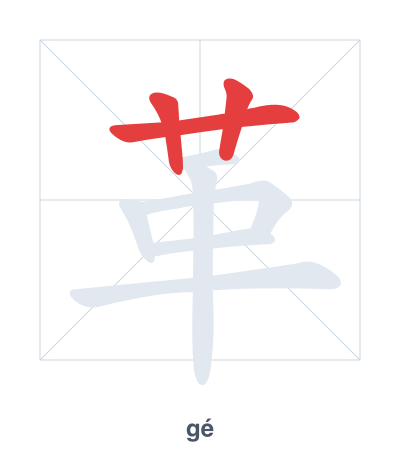
Open Hanzi Writer to see the animated stroke order and practice writing 革 with real-time feedback.
The character 革 (gé) is written with 9 strokes. Follow the standard Chinese stroke order: top to bottom, left to right, outside before inside. The radical 革 is one of its key components.
Practice the correct stroke order with the Hanzi Writer app to see animated stroke-by-stroke guidance with real-time feedback.
革 means Leather / to reform.
As an HSK Level 5 character, 革 is an intermediate-level character.
革 is a pictograph of a stretched animal hide, with the top part originally depicting the head and the bottom the tail. The ancient form showed the skin flayed and stretched on a frame, which directly conveys the meaning of leather, and later extended to 'reform' as in removing the old skin to make something new.
💡 Memory Tip: Imagine a cowhide stretched on a nine-shaped (strokes) drying rack, being reformed into a leather jacket.
这是一个伟大的革命。
zhè shì yí gè wěi dà de gé mìng
This is a great revolution.
国家正在进行改革。
guó jiā zhèng zài jìn xíng gǎi gé
The country is undergoing reforms.
这个包是皮革做的。
zhè ge bāo shì pí gé zuò de
This bag is made of leather.
Open Hanzi Writer to see the animated stroke order and practice writing 革 with real-time feedback.
✨ Animated stroke order · Handwriting recognition · HSK-graded practice · Free to use
革 is a pictograph that originally depicted an animal skin stretched out to be dried or tanned, which explains its meaning of "leather." The radical is the character itself, so it serves as both the component and the whole, making it a self-contained unit for leather-related ideas.