俺 (ǎn) means "I or me (dialect)" in Chinese. It has 10 strokes with the radical 亻.
Rated 3.9/5 in difficulty (challenging).
Appears in 3+ common words including 俺们 (ǎn men), 俺家 (ǎn jiā), 俺爹 (ǎn diē).
Due to its 10 strokes, Hanzi Writer's error detection shows 俺 requires focused practice — most learners need 10+ attempts for consistent accuracy.
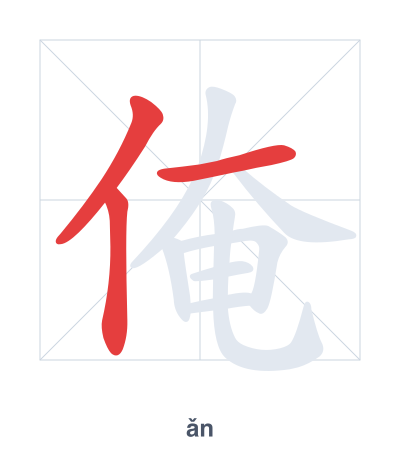
Open Hanzi Writer to see the animated stroke order and practice writing 俺 with real-time feedback.
The character 俺 (ǎn) is written with 10 strokes. Follow the standard Chinese stroke order: top to bottom, left to right, outside before inside. The radical 亻 is one of its key components.
Practice the correct stroke order with the Hanzi Writer app to see animated stroke-by-stroke guidance with real-time feedback.
俺 means I or me (dialect).
俺 is a compound character formed by the radical 亻 (person) and the phonetic component 奄 (yǎn). The component 奄 originally meant 'to cover' or 'suddenly', but here it provides the sound, while the overall character is used as a dialectal first-person pronoun meaning 'I' or 'me', especially in northern China.
💡 Memory Tip: Picture a person (亻) with a big head (大) and a wide mouth (日) saying 'I' in a strong northern accent: 'ǎn!'
俺们都是老乡。
ǎn men dōu shì lǎo xiāng
We are all fellow villagers.
欢迎来俺家玩。
huān yíng lái ǎn jiā wán
Welcome to my place.
俺爹在田里干活。
ǎn diē zài tián lǐ gàn huó
My dad is working in the field.
Open Hanzi Writer to see the animated stroke order and practice writing 俺 with real-time feedback.
✨ Animated stroke order · Handwriting recognition · HSK-graded practice · Free to use
俺 is made of the person radical 亻 on the left and 奄 (yǎn) on the right. The radical shows the character relates to a person, while 奄 mainly provides pronunciation. Together they create a dialectal word for "I" or "me."