恩 (ēn) means "kindness" in Chinese. It has 10 strokes with the radical 心, and is HSK Level 6.
Rated 4.2/5 in difficulty (advanced).
Harder than 59% of HSK Level 6 characters.
Appears in 3+ common words including 感恩 (gǎn ēn), 恩人 (ēn rén), 恩情 (ēn qíng).
Due to its 10 strokes, Hanzi Writer's error detection shows 恩 requires focused practice — most learners need 10+ attempts for consistent accuracy.
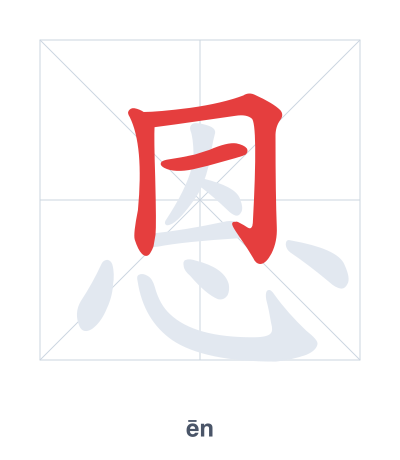
Open Hanzi Writer to see the animated stroke order and practice writing 恩 with real-time feedback.
The character 恩 (ēn) is written with 10 strokes. Follow the standard Chinese stroke order: top to bottom, left to right, outside before inside. The radical 心 is one of its key components.
Practice the correct stroke order with the Hanzi Writer app to see animated stroke-by-stroke guidance with real-time feedback.
恩 means kindness.
As an HSK Level 6 character, 恩 is an intermediate-level character.
恩 combines 因 (cause/reason) above 心 (heart), suggesting a kindness that arises from the heart's deliberate consideration of another's needs. The heart radical (心) emphasizes that true kindness is an emotional, heartfelt quality.
💡 Memory Tip: Picture a heart (心) trapped inside a square (因) — the kindness you feel when someone gives you a big, warm hug, holding you close.
我们要学会感恩。
wǒ men yào xué huì gǎn ēn
We should learn to be grateful.
他是我的恩人。
tā shì wǒ de ēn rén
He is my benefactor.
我忘不了你的恩情。
wǒ wàng bù liǎo nǐ de ēn qíng
I will never forget your kindness.
Open Hanzi Writer to see the animated stroke order and practice writing 恩 with real-time feedback.
✨ Animated stroke order · Handwriting recognition · HSK-graded practice · Free to use
恩 is made of two parts: the top is 因 (cause) and the bottom is 心 (heart). This structure suggests that kindness (恩) comes from the heart (心) in response to a cause or reason (因). Together they convey the idea of heartfelt gratitude or favor.