感 (gǎn) means "to feel / sense / emotion" in Chinese. It has 13 strokes with the radical 心, and is HSK Level 2.
Rated 3.7/5 in difficulty (challenging).
Harder than 75% of HSK Level 2 characters.
Appears in 3+ common words including 感觉 (gǎn jué), 感谢 (gǎn xiè), 感冒 (gǎn mào).
Due to its 13 strokes, Hanzi Writer's error detection shows 感 requires focused practice — most learners need 10+ attempts for consistent accuracy.
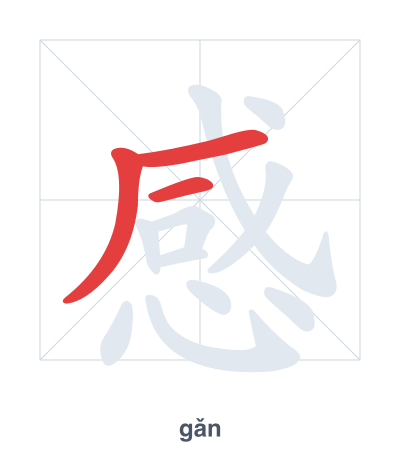
Open Hanzi Writer to see the animated stroke order and practice writing 感 with real-time feedback.
The character 感 (gǎn) is written with 13 strokes. Follow the standard Chinese stroke order: top to bottom, left to right, outside before inside. The radical 心 is one of its key components.
Practice the correct stroke order with the Hanzi Writer app to see animated stroke-by-stroke guidance with real-time feedback.
感 means to feel / sense / emotion.
As an HSK Level 2 character, 感 is among the first characters beginners learn.
感 combines 咸 (all/complete) as a phonetic hint and 心 (heart) to show that feelings arise in the heart. The character suggests that emotions fill the heart when stimulated by external experiences.
💡 Memory Tip: Imagine a heart (心) pierced by a salty tear (咸) to feel a deep emotion.
你现在感觉怎么样?
nǐ xiàn zài gǎn jué zěn me yàng
How do you feel now?
非常感谢你的帮助。
fēi cháng gǎn xiè nǐ de bāng zhù
Thank you very much for your help.
我今天感冒了。
wǒ jīn tiān gǎn mào le
I have a cold today.
Open Hanzi Writer to see the animated stroke order and practice writing 感 with real-time feedback.
✨ Animated stroke order · Handwriting recognition · HSK-graded practice · Free to use
感 is made of 咸 (all) on top and 心 (heart) on bottom. The idea is that feelings come from the heart and involve everything around you, so the character means 'to feel' or 'emotion'.