鹅 (é) means "Goose" in Chinese. It has 12 strokes with the radical 鸟, and is HSK Level 7.
Rated 4.2/5 in difficulty (advanced).
Harder than 100% of HSK Level 7 characters.
Appears in 3+ common words including 天鹅 (tiān é), 鹅毛 (é máo), 企鹅 (qǐ é).
Due to its 12 strokes, Hanzi Writer's error detection shows 鹅 requires focused practice — most learners need 10+ attempts for consistent accuracy.
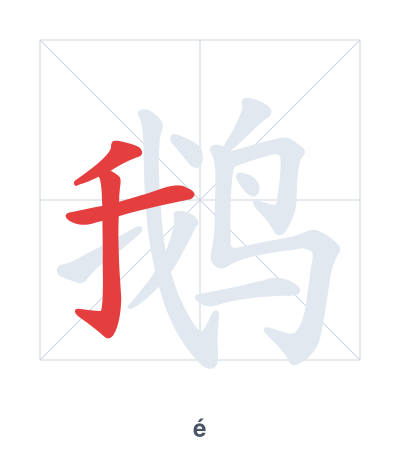
Open Hanzi Writer to see the animated stroke order and practice writing 鹅 with real-time feedback.
The character 鹅 (é) is written with 12 strokes. Follow the standard Chinese stroke order: top to bottom, left to right, outside before inside. The radical 鸟 is one of its key components.
Practice the correct stroke order with the Hanzi Writer app to see animated stroke-by-stroke guidance with real-time feedback.
鹅 means Goose.
As an HSK Level 7 character, 鹅 is an intermediate-level character.
鹅 combines the radical 鸟 (bird) with 我 (self, phonetic) to represent a domesticated bird. The left side 我 provides the sound, while 鸟 indicates it's a bird species—specifically a goose. This reflects how the character was formed as a phonetic-semantic compound.
💡 Memory Tip: Picture a goose strutting proudly, honking 'I (我) am a bird (鸟)!' as if proclaiming its own importance.
天鹅非常美丽。
tiān é fēi cháng měi lì
Swans are very beautiful.
外面下着鹅毛大雪。
wài miàn xià zhe é máo dà xuě
It is snowing heavily outside (like goose feathers).
企鹅不会飞。
qǐ é bú huì fēi
Penguins cannot fly.
Open Hanzi Writer to see the animated stroke order and practice writing 鹅 with real-time feedback.
✨ Animated stroke order · Handwriting recognition · HSK-graded practice · Free to use
鹅 is made of two parts: 我 on the left and 鸟 on the right. 鸟 means "bird," which shows that a goose is a type of bird. The left part 我 gives the pronunciation é, so together they form a phonetic-meaning compound.