讹 (é) means "Error / False / To extort" in Chinese. It has 6 strokes with the radical 讠, and is HSK Level 7.
Rated 2.9/5 in difficulty (moderate).
Harder than 7% of HSK Level 7 characters.
Appears in 3+ common words including 讹传 (é chuán), 讹诈 (é zhà), 讹误 (é wù).
Hanzi Writer's stroke validation shows learners typically need 5-8 attempts to write 讹 with correct proportion and order.
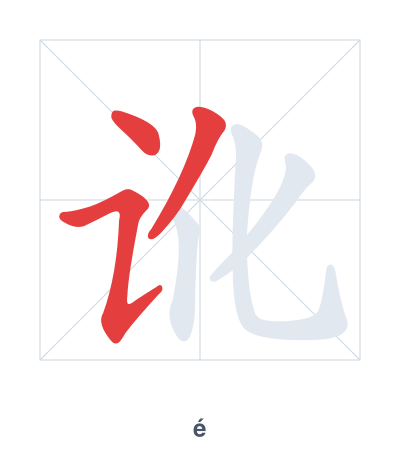
Open Hanzi Writer to see the animated stroke order and practice writing 讹 with real-time feedback.
The character 讹 (é) is written with 6 strokes. Follow the standard Chinese stroke order: top to bottom, left to right, outside before inside. The radical 讠 is one of its key components.
Practice the correct stroke order with the Hanzi Writer app to see animated stroke-by-stroke guidance with real-time feedback.
讹 means Error / False / To extort.
As an HSK Level 7 character, 讹 is an intermediate-level character.
讹 combines the speech radical 讠 (words) with 化 (to change/transform), literally meaning 'words that have been altered.' This visualizes the idea of twisting the truth — whether as an error, a falsehood, or using deceptive speech to extort someone.
💡 Memory Tip: Imagine a speaker (讠) whose words turn into a snake (化 looks like a coiled serpent) that bites the listener — that's a falsehood meant to extort.
这只是一个讹传。
zhè zhǐ shì yí gè é chuán
This is just a false rumor.
他想讹诈我的钱。
tā xiǎng é zhà wǒ de qián
He wants to extort money from me.
书里有很多讹误。
shū lǐ yǒu hěn duō é wù
There are many errors in the book.
Open Hanzi Writer to see the animated stroke order and practice writing 讹 with real-time feedback.
✨ Animated stroke order · Handwriting recognition · HSK-graded practice · Free to use
The left side 讠 (speech) indicates the character relates to speaking or words. The right side 化 (change) suggests altering or twisting speech, which connects to meanings like falsehood, error, or extortion.