洞 (dòng) means "Cave / Hole" in Chinese. It has 9 strokes with the radical 氵, and is HSK Level 5.
Rated 4/5 in difficulty (challenging).
Harder than 53% of HSK Level 5 characters.
Appears in 3+ common words including 山洞 (shān dòng), 破洞 (pò dòng), 漏洞 (lòu dòng).
Due to its 9 strokes, Hanzi Writer's error detection shows 洞 requires focused practice — most learners need 10+ attempts for consistent accuracy.
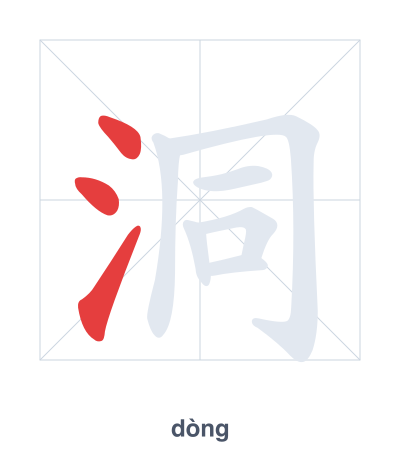
Open Hanzi Writer to see the animated stroke order and practice writing 洞 with real-time feedback.
The character 洞 (dòng) is written with 9 strokes. Follow the standard Chinese stroke order: top to bottom, left to right, outside before inside. The radical 氵 is one of its key components.
Practice the correct stroke order with the Hanzi Writer app to see animated stroke-by-stroke guidance with real-time feedback.
洞 means Cave / Hole.
As an HSK Level 5 character, 洞 is an intermediate-level character.
The character 洞 combines the water radical 氵 (shuǐ) with 同 (tóng, meaning 'same' or 'together'). Originally it depicted a deep cave or hole through which water flows, with 同 also contributing a phonetic hint and suggesting the idea of a continuous, uniform passage.
💡 Memory Tip: Picture a waterfall (氵) cascading into a dark cave, and a sign beside it reading '同' (all together), inviting everyone to explore the hole.
山里有一个大山洞。
shān lǐ yǒu yí gè dà shān dòng
There is a large cave in the mountains.
他的衣服有个破洞。
tā de yī fú yǒu gè pò dòng
There is a hole in his clothes.
这个计划有漏洞。
zhè ge jì huà yǒu lòu dòng
This plan has loopholes.
Open Hanzi Writer to see the animated stroke order and practice writing 洞 with real-time feedback.
✨ Animated stroke order · Handwriting recognition · HSK-graded practice · Free to use
洞 is made of the water radical 氵 on the left and the phonetic component 同 (tóng) on the right. The water radical hints at caves often found near water or with moisture, while 同 provides the pronunciation cue. Together they create the meaning of a cave or hole, especially one that may have water inside.