帝 (dì) means "Emperor." in Chinese. It has 9 strokes with the radical 巾, and is HSK Level 6.
Rated 4/5 in difficulty (challenging).
Harder than 46% of HSK Level 6 characters.
Appears in 3+ common words including 皇帝 (huáng dì), 帝国 (dì guó), 上帝 (shàng dì).
Due to its 9 strokes, Hanzi Writer's error detection shows 帝 requires focused practice — most learners need 10+ attempts for consistent accuracy.
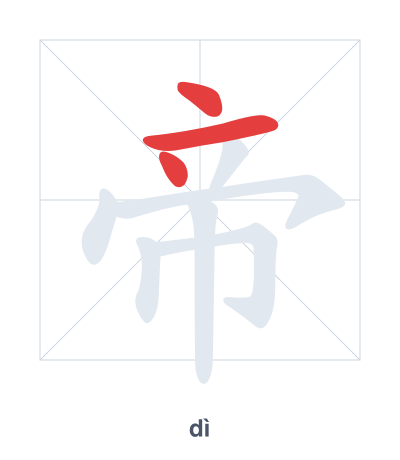
Open Hanzi Writer to see the animated stroke order and practice writing 帝 with real-time feedback.
The character 帝 (dì) is written with 9 strokes. Follow the standard Chinese stroke order: top to bottom, left to right, outside before inside. The radical 巾 is one of its key components.
Practice the correct stroke order with the Hanzi Writer app to see animated stroke-by-stroke guidance with real-time feedback.
帝 means Emperor..
As an HSK Level 6 character, 帝 is an intermediate-level character.
In ancient oracle bone script, 帝 originally depicted a ritual altar or a sacrificial stand, representing the supreme deity who rules over heaven and earth. Over time, the character came to symbolize the earthly emperor as the 'Son of Heaven' and the highest human authority. The top part resembles a crown or structure, while the lower 巾 (cloth) component suggests a ceremonial garment or banner of imperial power.
💡 Memory Tip: Visualize an emperor standing tall on a platform (the top strokes) with a flowing royal cloth (巾) draped beneath, marking his supreme rule.
中国古代有皇帝。
zhōng guó gǔ dài yǒu huáng dì
There were emperors in ancient China.
这是一个强大的帝国。
zhè shì yí gè qiáng dà de dì guó
This is a powerful empire.
他相信上帝。
tā xiāng xìn shàng dì
He believes in God.
Open Hanzi Writer to see the animated stroke order and practice writing 帝 with real-time feedback.
✨ Animated stroke order · Handwriting recognition · HSK-graded practice · Free to use
The character 帝 consists of three parts: the top 亠 (a lid or cover), the middle 冖 (a canopy), and the bottom 巾 (cloth). Together they suggest a canopy over a cloth, symbolizing the authority and majesty of an emperor. This structure was used in ancient times to represent a ceremonial display of power.