皇 (huáng) means "emperor / royal / grand" in Chinese. It has 9 strokes with the radical 白, and is HSK Level 6.
Rated 4/5 in difficulty (challenging).
Harder than 52% of HSK Level 6 characters.
Appears in 3+ common words including 皇帝 (huáng dì), 皇家 (huáng jiā), 皇宫 (huáng gōng).
Due to its 9 strokes, Hanzi Writer's error detection shows 皇 requires focused practice — most learners need 10+ attempts for consistent accuracy.
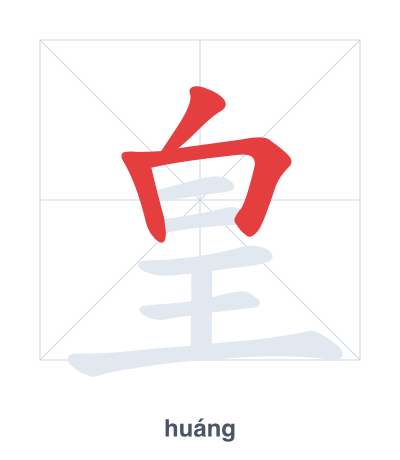
Open Hanzi Writer to see the animated stroke order and practice writing 皇 with real-time feedback.
The character 皇 (huáng) is written with 9 strokes. Follow the standard Chinese stroke order: top to bottom, left to right, outside before inside. The radical 白 is one of its key components.
Practice the correct stroke order with the Hanzi Writer app to see animated stroke-by-stroke guidance with real-time feedback.
皇 means emperor / royal / grand.
As an HSK Level 6 character, 皇 is an intermediate-level character.
Originally, 皇 depicted a torch or lamp (top part 白 representing a flame) on a stand (bottom part 王), symbolizing brightness and grandeur. Over time, this image of radiance came to represent the 'bright king' or emperor, who was seen as a shining ruler. The modern structure combines 白 (white/bright) and 王 (king), reinforcing the idea of a majestic sovereign.
💡 Memory Tip: Imagine an emperor wearing a dazzling white (白) crown, standing like a king (王) radiating divine light.
他是古代的皇帝。
tā shì gǔ dài de huáng dì
He was an emperor in ancient times.
这是皇家公园。
zhè shì huáng jiā gōng yuán
This is a royal park.
皇宫非常大。
huáng gōng fēi cháng dà
The imperial palace is very large.
Open Hanzi Writer to see the animated stroke order and practice writing 皇 with real-time feedback.
✨ Animated stroke order · Handwriting recognition · HSK-graded practice · Free to use
The character 皇 consists of 白 (white) on top and 王 (king) on the bottom. Together, they suggest a 'white king' or 'bright king,' which relates to the emperor as a powerful and luminous ruler.