德 (dé) means "virtue; morality" in Chinese. It has 15 strokes with the radical 彳, and is HSK Level 5.
Rated 4.2/5 in difficulty (advanced).
Harder than 65% of HSK Level 5 characters.
Appears in 3+ common words including 道德 (dào dé), 德国 (dé guó), 品德 (pǐn dé).
Due to its 15 strokes, Hanzi Writer's error detection shows 德 requires focused practice — most learners need 10+ attempts for consistent accuracy.
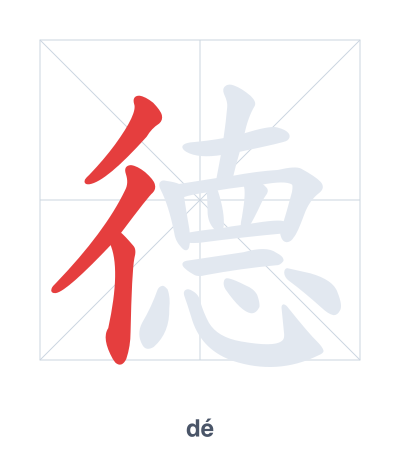
Open Hanzi Writer to see the animated stroke order and practice writing 德 with real-time feedback.
The character 德 (dé) is written with 15 strokes. Follow the standard Chinese stroke order: top to bottom, left to right, outside before inside. The radical 彳 is one of its key components.
Practice the correct stroke order with the Hanzi Writer app to see animated stroke-by-stroke guidance with real-time feedback.
德 means virtue; morality.
As an HSK Level 5 character, 德 is an intermediate-level character.
德 combines the radical 彳 (action or step) with the phonetic component 㥁, itself a fusion of 直 (straight) and 心 (heart). The original meaning was 'to act uprightly from the heart,' emphasizing moral conduct as a straight path guided by one's inner conscience.
💡 Memory Tip: Walk (彳) with ten (十) people, four (四) hearts (心), all in one (一) direction—that's virtue.
我们要讲究道德。
wǒ men yào jiǎng jiū dào dé
We should emphasize morality.
他去年去了德国。
tā qù nián qù le dé guó
He went to Germany last year.
他的品德很高尚。
tā de pǐn dé hěn gāo shàng
His character is very noble.
Open Hanzi Writer to see the animated stroke order and practice writing 德 with real-time feedback.
✨ Animated stroke order · Handwriting recognition · HSK-graded practice · Free to use
德 is composed of the radical 彳 (step) on the left, and the right side contains 直 (straight) and 心 (heart). Together, this suggests walking straight with a straight heart, which represents moral conduct and virtue.