徯 (xī) means "to wait; to expect" in Chinese. It has 13 strokes with the radical 彳.
Rated 4.2/5 in difficulty (advanced).
Appears in 3+ common words including 徯径 (xī jìng), 徯望 (xī wàng), 徯后 (xī hòu).
Due to its 13 strokes, Hanzi Writer's error detection shows 徯 requires focused practice — most learners need 10+ attempts for consistent accuracy.
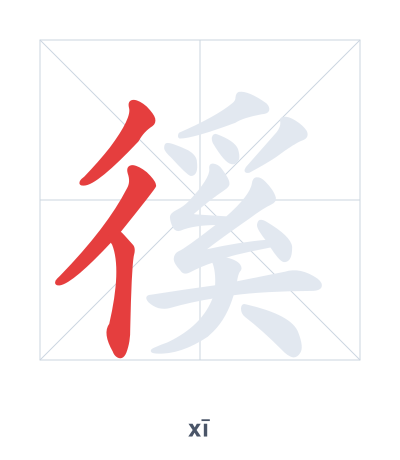
Open Hanzi Writer to see the animated stroke order and practice writing 徯 with real-time feedback.
The character 徯 (xī) is written with 13 strokes. Follow the standard Chinese stroke order: top to bottom, left to right, outside before inside. The radical 彳 is one of its key components.
Practice the correct stroke order with the Hanzi Writer app to see animated stroke-by-stroke guidance with real-time feedback.
徯 means to wait; to expect.
This character is a phono-semantic compound. The left radical 彳 (meaning 'step' or 'action') suggests the waiting involves staying in place on a path, while the right component 奚 provides the pronunciation xī. In ancient texts, 徯 originally meant 'to wait' or 'to expect,' often with an implication of anticipation along a journey.
💡 Memory Tip: Picture yourself waiting on a path (彳) for a puppet master to lower a hand (爫) holding silk strings (糸) over a big performer (大)—you're full of expectation for the show to start.
山间有一条徯径。
shān jiān yǒu yī tiáo xī jìng
There is a narrow path in the mountains.
他在徯望好消息。
tā zài xī wàng hǎo xiāo xī
He is waiting for good news.
这里的百姓在徯后。
zhè lǐ de bǎi xìng zài xī hòu
The people here are waiting for their leader.
Open Hanzi Writer to see the animated stroke order and practice writing 徯 with real-time feedback.
✨ Animated stroke order · Handwriting recognition · HSK-graded practice · Free to use
徯 is made of the radical 彳 on the left, which represents walking or a path, and the component 奚 on the right, which gives the sound "xī". Together, they suggest standing on a path while waiting or expecting something.