党 (dǎng) means "party / political party" in Chinese. It has 10 strokes with the radical 儿, and is HSK Level 6.
Rated 3.9/5 in difficulty (challenging).
Harder than 39% of HSK Level 6 characters.
Appears in 3+ common words including 党员 (dǎng yuán), 入党 (rù dǎng), 同党 (tóng dǎng).
Due to its 10 strokes, Hanzi Writer's error detection shows 党 requires focused practice — most learners need 10+ attempts for consistent accuracy.
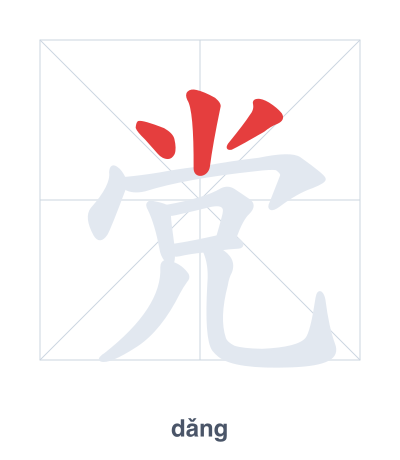
Open Hanzi Writer to see the animated stroke order and practice writing 党 with real-time feedback.
The character 党 (dǎng) is written with 10 strokes. Follow the standard Chinese stroke order: top to bottom, left to right, outside before inside. The radical 儿 is one of its key components.
Practice the correct stroke order with the Hanzi Writer app to see animated stroke-by-stroke guidance with real-time feedback.
党 means party / political party.
As an HSK Level 6 character, 党 is an intermediate-level character.
The character 党 is the simplified form of 黨, which originally combined 尚 (phonetic, meaning 'still' or 'esteemed') and 黑 (black, hinting at a secret or hidden group). In the modern form, 尚 (a roof-like shape) and 儿 (a person) together suggest a group of people united under a common banner or leader, evoking the idea of a political party.
💡 Memory Tip: Picture a political party where every member (儿) must stand still (尚) during the leader's speech.
他是一名老党员。
tā shì yī míng lǎo dǎng yuán
He is a veteran Party member.
他去年申请入党。
tā qù nián shēn qǐng rù dǎng
He applied to join the Party last year.
他们是同党。
tā men shì tóng dǎng
They are accomplices.
Open Hanzi Writer to see the animated stroke order and practice writing 党 with real-time feedback.
✨ Animated stroke order · Handwriting recognition · HSK-graded practice · Free to use
党 is composed of the top part 尚 (meaning "still" or "yet") and the bottom radical 儿 (legs). However, the modern meaning of "party" or "political party" comes from its use in political contexts, not directly from its components. The structure shows that 党 is a phono-semantic compound where the top suggests pronunciation and the bottom is a simplified form of 人 (person), hinting at groups of people.