瘁 (cuì) means "overworked; weary; distressed" in Chinese. It has 13 strokes with the radical 疒.
Rated 4.2/5 in difficulty (advanced).
Appears in 3+ common words including 心力交瘁 (xīn lì jiāo cuì), 鞠躬尽瘁 (jū gōng jìn cuì), 劳瘁 (láo cuì).
Due to its 13 strokes, Hanzi Writer's error detection shows 瘁 requires focused practice — most learners need 10+ attempts for consistent accuracy.
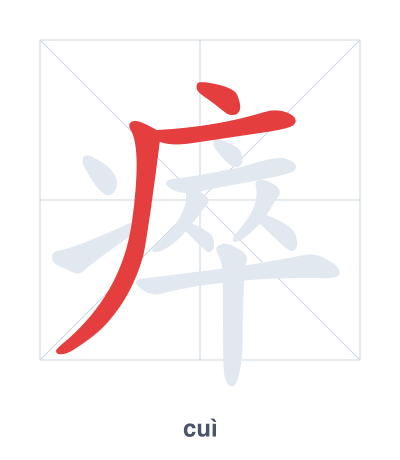
Open Hanzi Writer to see the animated stroke order and practice writing 瘁 with real-time feedback.
The character 瘁 (cuì) is written with 13 strokes. Follow the standard Chinese stroke order: top to bottom, left to right, outside before inside. The radical 疒 is one of its key components.
Practice the correct stroke order with the Hanzi Writer app to see animated stroke-by-stroke guidance with real-time feedback.
瘁 means overworked; weary; distressed.
The character 瘁 combines the illness radical 疒 with the phonetic component 卒 (zú, meaning 'soldier' or 'sudden death'). The radical indicates a state of sickness, while 卒 suggests the extreme exhaustion or collapse that comes from overwork, as if one has 'died on one's feet.'
💡 Memory Tip: Picture a soldier (卒) collapsing onto a hospital bed (疒) after endless drills, utterly overworked and weary.
他最近感到心力交瘁。
tā zuì jìn gǎn dào xīn lì jiāo cuì
He has been feeling physically and mentally exhausted lately.
他为工作鞠躬尽瘁。
tā wèi gōng zuò jū gōng jìn cuì
He gave his all to his work.
长期的劳瘁让他病了。
cháng qī de láo cuì ràng tā bìng le
Long-term overwork made him ill.
Open Hanzi Writer to see the animated stroke order and practice writing 瘁 with real-time feedback.
✨ Animated stroke order · Handwriting recognition · HSK-graded practice · Free to use
瘁 has the radical 疒 (sickness) on the outside, which shows the meaning is related to illness or exhaustion. Inside is 卒 (zú, soldier), suggesting a soldier so overworked that he becomes sick — thus "overworked" and "weary."