粝 (lì) means "coarse (grain)" in Chinese. It has 11 strokes with the radical 米.
Rated 4.2/5 in difficulty (advanced).
Appears in 3+ common words including 粝米 (lì mǐ), 粗粝 (cū lì), 粝食 (lì shí).
Due to its 11 strokes, Hanzi Writer's error detection shows 粝 requires focused practice — most learners need 10+ attempts for consistent accuracy.
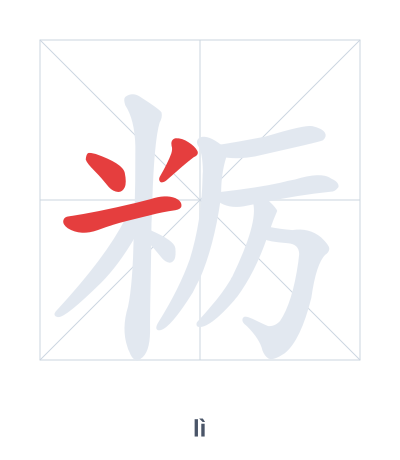
Open Hanzi Writer to see the animated stroke order and practice writing 粝 with real-time feedback.
The character 粝 (lì) is written with 11 strokes. Follow the standard Chinese stroke order: top to bottom, left to right, outside before inside. The radical 米 is one of its key components.
Practice the correct stroke order with the Hanzi Writer app to see animated stroke-by-stroke guidance with real-time feedback.
粝 means coarse (grain).
This character is a phono-semantic compound. The radical 米 (rice/grain) indicates the meaning relates to grain, while 历 (lì) provides the pronunciation and subtly suggests the idea of roughness through its components: 厂 (cliff) and 力 (force) together evoke the image of grain being harshly processed.
💡 Memory Tip: Picture a grain of rice (米) under a cliff (厂) getting smashed by force (力), turning it into coarse, rough grain.
粝米对身体很有好处。
lì mǐ duì shēn tǐ hěn yǒu hǎo chù
Brown rice is very good for the body.
这种纸的手感很粗粝。
zhè zhǒng zhǐ de shǒu gǎn hěn cū lì
This paper feels very coarse.
他习惯了吃这种粝食。
tā xí guàn le chī zhè zhǒng lì shí
He is used to eating this kind of coarse food.
Open Hanzi Writer to see the animated stroke order and practice writing 粝 with real-time feedback.
✨ Animated stroke order · Handwriting recognition · HSK-graded practice · Free to use
The left part is 米 (rice), showing that the character relates to grain or food. The right part is 厉, which gives the pronunciation lì and also hints at the idea of roughness or strictness. Together, they suggest grain that is not refined — that is, coarse rice.