葱 (cōng) means "scallion / green onion" in Chinese. It has 12 strokes with the radical 艹, and is HSK Level 7.
Rated 4.2/5 in difficulty (advanced).
Harder than 87% of HSK Level 7 characters.
Appears in 3+ common words including 大葱 (dà cōng), 葱花 (cōng huā), 洋葱 (yáng cōng).
Due to its 12 strokes, Hanzi Writer's error detection shows 葱 requires focused practice — most learners need 10+ attempts for consistent accuracy.
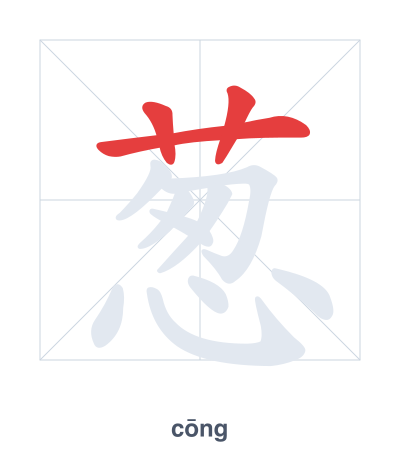
Open Hanzi Writer to see the animated stroke order and practice writing 葱 with real-time feedback.
The character 葱 (cōng) is written with 12 strokes. Follow the standard Chinese stroke order: top to bottom, left to right, outside before inside. The radical 艹 is one of its key components.
Practice the correct stroke order with the Hanzi Writer app to see animated stroke-by-stroke guidance with real-time feedback.
葱 means scallion / green onion.
As an HSK Level 7 character, 葱 is an intermediate-level character.
葱 is a phono-semantic compound: the radical 艹 (grass) indicates it is a plant, while 悤 (cōng, meaning 'hurried') provides the pronunciation. The ancient form of 悤 shows a window (囪) and a heart (心), but here it simply acts as a sound component. Thus, 葱 literally refers to the scallion or green onion plant.
💡 Memory Tip: Imagine a green onion (艹) with a tiny heart (心) inside that beats so fast it makes you cry (悤 sounds like 'cong' as in 'congestion' of tears).
我去买大葱。
wǒ qù mǎi dà cōng
I'm going to buy scallions.
汤里撒点葱花。
tāng lǐ sā diǎn cōng huā
Sprinkle some chopped green onions in the soup.
我不喜欢洋葱。
wǒ bù xǐ huān yáng cōng
I don't like onions.
Open Hanzi Writer to see the animated stroke order and practice writing 葱 with real-time feedback.
✨ Animated stroke order · Handwriting recognition · HSK-graded practice · Free to use
葱 is made of the grass radical 艹 on top and the phonetic component 匆 (cōng) below. The grass radical shows that it is a plant, and 匆 helps with pronunciation. This structure tells you that 葱 is a type of plant (scallion) that sounds like 匆.