痴 (chī) means "dementia; infatuated; silly" in Chinese. It has 13 strokes with the radical 疒, and is HSK Level 7.
Rated 4.2/5 in difficulty (advanced).
Harder than 73% of HSK Level 7 characters.
Appears in 3+ common words including 痴迷 (chī mí), 痴心 (chī xīn), 痴呆 (chī dāi).
Due to its 13 strokes, Hanzi Writer's error detection shows 痴 requires focused practice — most learners need 10+ attempts for consistent accuracy.
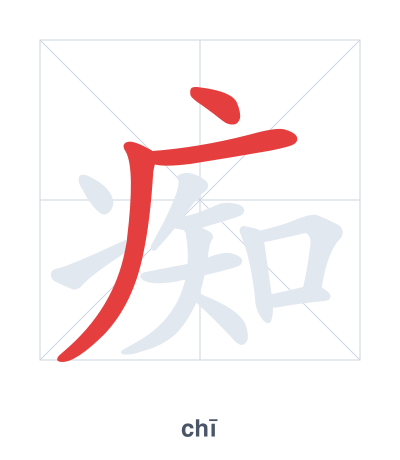
Open Hanzi Writer to see the animated stroke order and practice writing 痴 with real-time feedback.
The character 痴 (chī) is written with 13 strokes. Follow the standard Chinese stroke order: top to bottom, left to right, outside before inside. The radical 疒 is one of its key components.
Practice the correct stroke order with the Hanzi Writer app to see animated stroke-by-stroke guidance with real-time feedback.
痴 means dementia; infatuated; silly.
As an HSK Level 7 character, 痴 is an intermediate-level character.
痴 combines the illness radical 疒 with 知 (knowledge/wisdom), suggesting a 'sickness of wisdom'—a state where one's knowing is impaired, leading to foolishness or infatuation.
💡 Memory Tip: Picture a sick person (疒) who stubbornly thinks they know (知) the answer but is completely wrong, acting silly and demented.
他痴迷于学习汉语。
tā chī mí yú xué xí hàn yǔ
He is obsessed with learning Chinese.
这只是他的痴心妄想。
zhè zhǐ shì tā de chī xīn wàng xiǎng
This is just his wishful thinking.
老人患了老年痴呆。
lǎo rén huàn le lǎo nián chī dāi
The elderly person suffers from Alzheimer's disease or dementia.
Open Hanzi Writer to see the animated stroke order and practice writing 痴 with real-time feedback.
✨ Animated stroke order · Handwriting recognition · HSK-graded practice · Free to use
痴 combines the radical 疒 (illness shack) on the left with the phonetic component 知 (knowledge) on the right. The radical suggests a sickness or abnormal state, while 知 implies knowledge gone wrong — together they create the idea of a mind that is "sick" or confused, leading to meanings like dementia, infatuation, or silliness.