贫 (pín) means "Poor / Impoverished" in Chinese. It has 8 strokes with the radical 贝, and is HSK Level 6.
Rated 3.7/5 in difficulty (challenging).
Harder than 36% of HSK Level 6 characters.
Appears in 3+ common words including 贫穷 (pín qióng), 贫困 (pín kùn), 贫血 (pín xuè).
Due to its 8 strokes, Hanzi Writer's error detection shows 贫 requires focused practice — most learners need 10+ attempts for consistent accuracy.
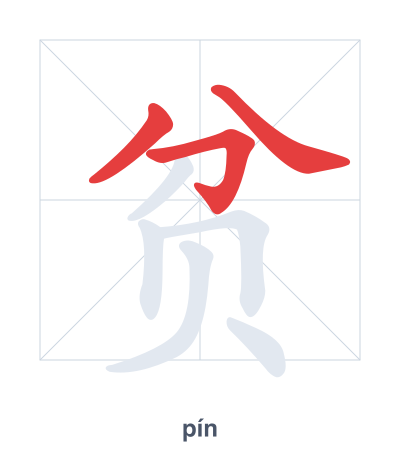
Open Hanzi Writer to see the animated stroke order and practice writing 贫 with real-time feedback.
The character 贫 (pín) is written with 8 strokes. Follow the standard Chinese stroke order: top to bottom, left to right, outside before inside. The radical 贝 is one of its key components.
Practice the correct stroke order with the Hanzi Writer app to see animated stroke-by-stroke guidance with real-time feedback.
贫 means Poor / Impoverished.
As an HSK Level 6 character, 贫 is an intermediate-level character.
贫 combines '分' (to divide) and '贝' (shells, ancient money), depicting wealth being divided until little remains, leading to poverty.
💡 Memory Tip: Picture a poor person desperately dividing (分) their last shell (贝) into crumbs.
他的家乡很贫穷。
tā de jiā xiāng hěn pín qióng
His hometown is very poor.
帮助贫困的孩子。
bāng zhù pín kùn de hái zi
Help children in poverty.
医生说我有点贫血。
yī shēng shuō wǒ yǒu diǎn pín xuè
The doctor said I am a bit anemic.
Open Hanzi Writer to see the animated stroke order and practice writing 贫 with real-time feedback.
✨ Animated stroke order · Handwriting recognition · HSK-graded practice · Free to use
贫 combines 贝 (money/shell) on the bottom with 分 (divide) on top. Together they suggest that when money is divided up, each person gets little, leading to poverty. This visual combination directly supports the character's meaning of being poor.