拆 (chāi) means "to tear open; to dismantle; to demolish" in Chinese. It has 8 strokes with the radical 扌, and is HSK Level 5.
Rated 3.7/5 in difficulty (challenging).
Harder than 35% of HSK Level 5 characters.
Appears in 3+ common words including 拆开 (chāi kāi), 拆迁 (chāi qiān), 拆信 (chāi xìn).
Due to its 8 strokes, Hanzi Writer's error detection shows 拆 requires focused practice — most learners need 10+ attempts for consistent accuracy.
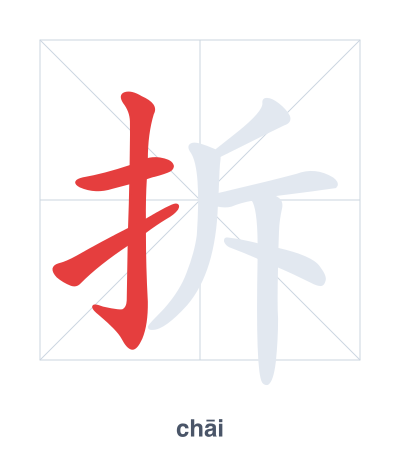
Open Hanzi Writer to see the animated stroke order and practice writing 拆 with real-time feedback.
The character 拆 (chāi) is written with 8 strokes. Follow the standard Chinese stroke order: top to bottom, left to right, outside before inside. The radical 扌 is one of its key components.
Practice the correct stroke order with the Hanzi Writer app to see animated stroke-by-stroke guidance with real-time feedback.
拆 means to tear open; to dismantle; to demolish.
As an HSK Level 5 character, 拆 is an intermediate-level character.
拆 combines the hand radical 扌 with 斥, which originally depicted a person being pushed away or a split. Together, they show using hands to tear open or dismantle something.
💡 Memory Tip: Picture a hand (扌) grabbing a piece of metal (the right side 斥 looks like a bent nail) and pulling it apart to dismantle it.
我拆开了礼物。
wǒ chāi kāi le lǐ wù
I opened the gift.
这里要拆迁了。
zhè lǐ yào chāi qiān le
This area is about to be demolished and relocated.
他正在拆信。
tā zhèng zài chāi xìn
He is opening a letter.
Open Hanzi Writer to see the animated stroke order and practice writing 拆 with real-time feedback.
✨ Animated stroke order · Handwriting recognition · HSK-graded practice · Free to use
拆 is made of the hand radical 扌 on the left and the character 斥 on the right. The hand radical suggests an action done with hands, while 斥 means to reject or separate, together they show the idea of using hands to separate or tear something apart.