策 (cè) means "Policy; plan; strategy" in Chinese. It has 12 strokes with the radical 竹, and is HSK Level 6.
Rated 4.2/5 in difficulty (advanced).
Harder than 82% of HSK Level 6 characters.
Appears in 3+ common words including 政策 (zhèng cè), 对策 (duì cè), 策划 (cè huà).
Due to its 12 strokes, Hanzi Writer's error detection shows 策 requires focused practice — most learners need 10+ attempts for consistent accuracy.
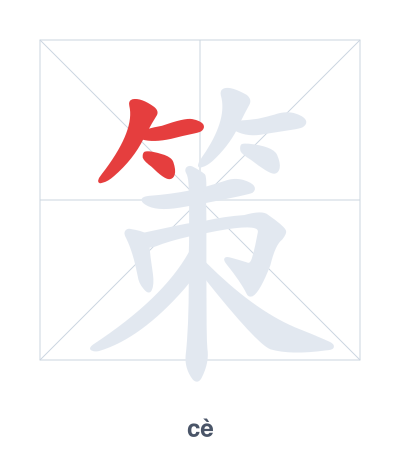
Open Hanzi Writer to see the animated stroke order and practice writing 策 with real-time feedback.
The character 策 (cè) is written with 12 strokes. Follow the standard Chinese stroke order: top to bottom, left to right, outside before inside. The radical 竹 is one of its key components.
Practice the correct stroke order with the Hanzi Writer app to see animated stroke-by-stroke guidance with real-time feedback.
策 means Policy; plan; strategy.
As an HSK Level 6 character, 策 is an intermediate-level character.
策 is a compound character. Its radical 竹 (bamboo) reflects that ancient Chinese strategies and policies were written on bamboo slips. The right component 朿 (cì) originally depicted a thorn or prickle, but here serves as a phonetic hint, while also suggesting the sharp, decisive nature of planning.
💡 Memory Tip: Picture a bamboo (⺮) whip cracking as you execute a cunning strategy (策)—the sound 'cè' is the snap of a plan coming together.
这个政策很好。
zhè ge zhèng cè hěn hǎo
This policy is very good.
我们有对策了。
wǒ men yǒu duì cè le
We have a strategy.
他在策划活动。
tā zài cè huà huó dòng
He is planning an activity.
Open Hanzi Writer to see the animated stroke order and practice writing 策 with real-time feedback.
✨ Animated stroke order · Handwriting recognition · HSK-graded practice · Free to use
策 is composed of the radical 竹 (bamboo) at the top and the phonetic component 朿 (cì) below. Bamboo was historically used for writing strips and documents, so the radical connects to writing plans or strategies. The overall character conveys the idea of a written policy or strategy.