胞 (bāo) means "Cell; sibling" in Chinese. It has 9 strokes with the radical 月, and is HSK Level 6.
Rated 4/5 in difficulty (challenging).
Harder than 53% of HSK Level 6 characters.
Appears in 3+ common words including 细胞 (xì bāo), 同胞 (tóng bāo), 胞弟 (bāo dì).
Due to its 9 strokes, Hanzi Writer's error detection shows 胞 requires focused practice — most learners need 10+ attempts for consistent accuracy.
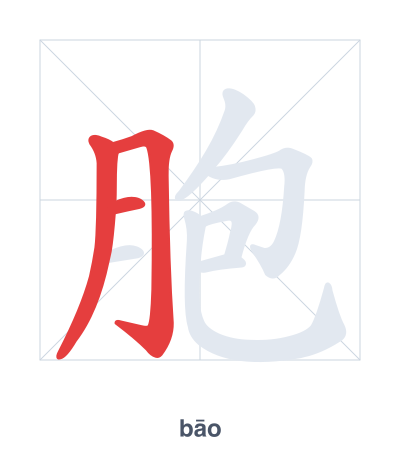
Open Hanzi Writer to see the animated stroke order and practice writing 胞 with real-time feedback.
The character 胞 (bāo) is written with 9 strokes. Follow the standard Chinese stroke order: top to bottom, left to right, outside before inside. The radical 月 is one of its key components.
Practice the correct stroke order with the Hanzi Writer app to see animated stroke-by-stroke guidance with real-time feedback.
胞 means Cell; sibling.
As an HSK Level 6 character, 胞 is an intermediate-level character.
胞 combines the flesh radical 月 (meat/body) with 包 (to wrap), depicting a fetus or organ wrapped in a membrane. This originally referred to the womb or afterbirth, and later broadened to mean 'cell' (a wrapped unit of life) and 'sibling' (from the same womb).
💡 Memory Tip: Imagine a little cell wrapped in a cozy bag (包) made of flesh (月) — that's your body's tiny sibling living inside.
细胞是生命的基本单位。
xì bāo shì shēng mìng de jī běn dān wèi
Cells are the basic unit of life.
我们是亲同胞兄弟。
wǒ men shì qīn tóng bāo xiōng dì
We are biological brothers.
他是我的亲胞弟。
tā shì wǒ de qīn bāo dì
He is my biological younger brother.
Open Hanzi Writer to see the animated stroke order and practice writing 胞 with real-time feedback.
✨ Animated stroke order · Handwriting recognition · HSK-graded practice · Free to use
胞 is made of the radical 月 on the left and the phonetic component 包 on the right. The radical 月 indicates flesh or body, and 包 provides the sound. Together they suggest something from the same body, like a biological cell or a sibling from the same womb.