摇 (yáo) means "to shake; to rock; to wave" in Chinese. It has 13 strokes with the radical 扌, and is HSK Level 4.
Rated 4.2/5 in difficulty (advanced).
Harder than 71% of HSK Level 4 characters.
Appears in 3+ common words including 摇头 (yáo tóu), 摇晃 (yáo huàng), 摇动 (yáo dòng).
Due to its 13 strokes, Hanzi Writer's error detection shows 摇 requires focused practice — most learners need 10+ attempts for consistent accuracy.
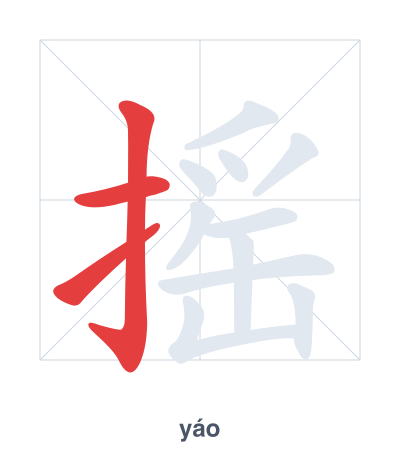
Open Hanzi Writer to see the animated stroke order and practice writing 摇 with real-time feedback.
The character 摇 (yáo) is written with 13 strokes. Follow the standard Chinese stroke order: top to bottom, left to right, outside before inside. The radical 扌 is one of its key components.
Practice the correct stroke order with the Hanzi Writer app to see animated stroke-by-stroke guidance with real-time feedback.
摇 means to shake; to rock; to wave.
As an HSK Level 4 character, 摇 is an intermediate-level character.
摇 is a compound character with the hand radical 扌 on the left, indicating an action performed by the hand, and the phonetic component 䍃 (yáo) on the right, which originally depicted a hand or claw holding a pottery vessel. The hand radical directly ties the character to movements like shaking, rocking, or waving.
💡 Memory Tip: Picture your hand (扌) gripping a pottery jar (缶) with a claw (爫) on top and shaking it vigorously to rock it back and forth.
他摇了摇头表示不同意。
tā yáo le yáo tóu biǎo shì bù tóng yì
He shook his head to show disagreement.
小船在水面摇晃。
xiǎo chuán zài shuǐ miàn yáo huàng
The small boat is rocking on the water.
请摇动这个小铃铛。
qǐng yáo dòng zhè ge xiǎo líng dāng
Please shake this little bell.
Open Hanzi Writer to see the animated stroke order and practice writing 摇 with real-time feedback.
✨ Animated stroke order · Handwriting recognition · HSK-graded practice · Free to use
摇 is made of the hand radical 扌 on the left and the phonetic component 䍃 on the right. The hand radical shows that the action involves the hand, which matches the meaning of shaking or waving. The right side gives a clue to the pronunciation, but does not directly relate to the meaning.