硅 (guī) means "Silicon" in Chinese. It has 11 strokes with the radical 石.
Rated 4.2/5 in difficulty (advanced).
Appears in 3+ common words including 硅谷 (guī gǔ), 硅片 (guī piàn), 硅胶 (guī jiāo).
Due to its 11 strokes, Hanzi Writer's error detection shows 硅 requires focused practice — most learners need 10+ attempts for consistent accuracy.
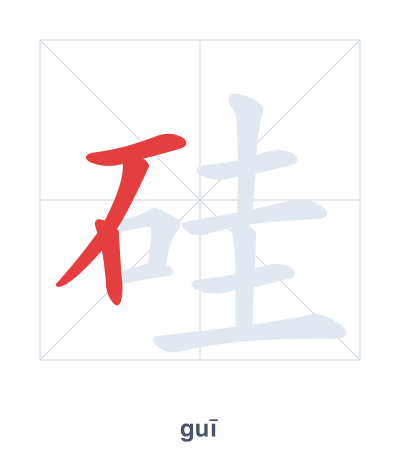
Open Hanzi Writer to see the animated stroke order and practice writing 硅 with real-time feedback.
The character 硅 (guī) is written with 11 strokes. Follow the standard Chinese stroke order: top to bottom, left to right, outside before inside. The radical 石 is one of its key components.
Practice the correct stroke order with the Hanzi Writer app to see animated stroke-by-stroke guidance with real-time feedback.
硅 means Silicon.
硅 is a compound character: the left radical 石 (stone) indicates it's a mineral, while the right component 圭 (guī, a jade tablet) provides the sound. Silicon is a common element in sand and stone, hence the stone radical.
💡 Memory Tip: Picture a shiny silicon chip shaped like a jade tablet (圭) sitting on a stone (石), glowing with electronic power.
他在硅谷工作。
tā zài guī gǔ gōng zuò
He works in Silicon Valley.
电脑芯片需要硅片。
diàn nǎo xīn piàn xū yào guī piàn
Computer chips require silicon wafers.
这个手机壳是硅胶的。
zhè ge shǒu jī ké shì guī jiāo de
This phone case is made of silicone.
Open Hanzi Writer to see the animated stroke order and practice writing 硅 with real-time feedback.
✨ Animated stroke order · Handwriting recognition · HSK-graded practice · Free to use
硅 is composed of the radical 石 (meaning stone or rock) on the left, and the phonetic component 圭 (guī, meaning a jade tablet) on the right. The 石 radical indicates that silicon is a solid, rock-like element found in sand and stone. The 圭 component provides the sound guī and hints at the element's crystalline, gem-like structure in its pure form.