硇 (náo) means "Sal ammoniac" in Chinese. It has 11 strokes with the radical 石.
Rated 4.2/5 in difficulty (advanced).
Appears in 3+ common words including 硇砂 (náo shā), 硇洲 (náo zhōu), 硇水 (náo shuǐ).
Due to its 11 strokes, Hanzi Writer's error detection shows 硇 requires focused practice — most learners need 10+ attempts for consistent accuracy.
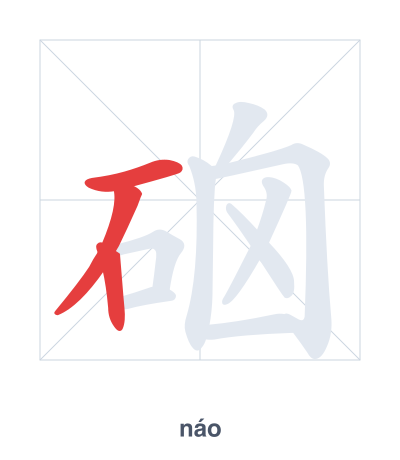
Open Hanzi Writer to see the animated stroke order and practice writing 硇 with real-time feedback.
The character 硇 (náo) is written with 11 strokes. Follow the standard Chinese stroke order: top to bottom, left to right, outside before inside. The radical 石 is one of its key components.
Practice the correct stroke order with the Hanzi Writer app to see animated stroke-by-stroke guidance with real-time feedback.
硇 means Sal ammoniac.
硇 is a phono-semantic compound: the radical 石 (stone) indicates it is a mineral, and the component 囟 (xìn, fontanelle) provides a phonetic hint (though not exact) and may reference its granular or crystalline appearance. Sal ammoniac is a whitish mineral salt, hence the stone radical.
💡 Memory Tip: Imagine a stone (石) with a soft, fontanelle-like depression (囟) that releases a sharp ammonia smell—that's sal ammoniac.
硇砂是一种矿物。
náo shā shì yī zhǒng kuàng wù
Sal ammoniac is a type of mineral.
硇洲岛在广东。
náo zhōu dǎo zài guǎng dōng
Naozhou Island is in Guangdong.
硇水有药用价值。
náo shuǐ yǒu yào yòng jià zhí
Nitric acid has medicinal value.
Open Hanzi Writer to see the animated stroke order and practice writing 硇 with real-time feedback.
✨ Animated stroke order · Handwriting recognition · HSK-graded practice · Free to use
硇 is a left-right structure character. The left radical 石 means 'stone' or 'rock', and the right part 卤 (lǔ) is a phonetic component that also hints at saltiness, since 硇 refers to a mineral salt called sal ammoniac.