饿 (è) means "Hungry" in Chinese. It has 10 strokes with the radical 饣, and is HSK Level 1.
Rated 3.7/5 in difficulty (challenging).
Harder than 100% of HSK Level 1 characters.
Appears in 3+ common words including 饿了 (è le), 饥饿 (jī è), 饿死 (è sǐ).
Due to its 10 strokes, Hanzi Writer's error detection shows 饿 requires focused practice — most learners need 10+ attempts for consistent accuracy.
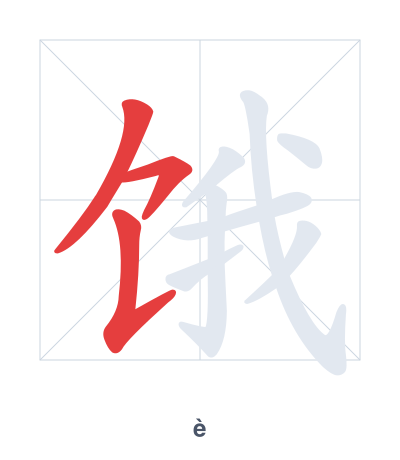
Open Hanzi Writer to see the animated stroke order and practice writing 饿 with real-time feedback.
The character 饿 (è) is written with 10 strokes. Follow the standard Chinese stroke order: top to bottom, left to right, outside before inside. The radical 饣 is one of its key components.
Practice the correct stroke order with the Hanzi Writer app to see animated stroke-by-stroke guidance with real-time feedback.
饿 means Hungry.
As an HSK Level 1 character, 饿 is among the first characters beginners learn.
The character 饿 combines the radical 饣 (food, a simplified form of 食) with the phonetic component 我 (wǒ, meaning 'I' or 'self'). Together, they suggest 'I need food', directly conveying the meaning of hunger. The left side pictographically represents a food container or meal, while the right side hints at the personal experience of hunger.
💡 Memory Tip: Picture yourself (我) craving food (饣) so badly that even the word itself looks like it's about to eat you.
我真的饿了。
wǒ zhēn de è le
I'm really hungry.
我们要减少饥饿。
wǒ men yào jiǎn shǎo jī è
We must reduce hunger.
我快要饿死了。
wǒ kuài yào è sǐ le
I'm starving.
Open Hanzi Writer to see the animated stroke order and practice writing 饿 with real-time feedback.
✨ Animated stroke order · Handwriting recognition · HSK-graded practice · Free to use
饿 consists of the radical 饣 (food/eat) on the left and 我 (I/self) on the right. The radical 饣 tells you the character is related to food or eating, while 我 gives a clue to the pronunciation (è). Together, they create the idea of "I need food" — being hungry.