Hanzi Writer

How to Write 鄹 (zōu) — Meaning “Zou (an ancient place name)”

zōu 16 strokes Radical: 阝

鄹 (zōu) means "Zou (an ancient place name)" in Chinese. It has 16 strokes with the radical 阝.

Rated 3.9/5 in difficulty (challenging).

Appears in 3+ common words including 鄹邑 (zōu yì), 鄹人 (zōu rén), 鄹见 (zōu jiàn).

Due to its 16 strokes, Hanzi Writer's error detection shows 鄹 requires focused practice — most learners need 10+ attempts for consistent accuracy.
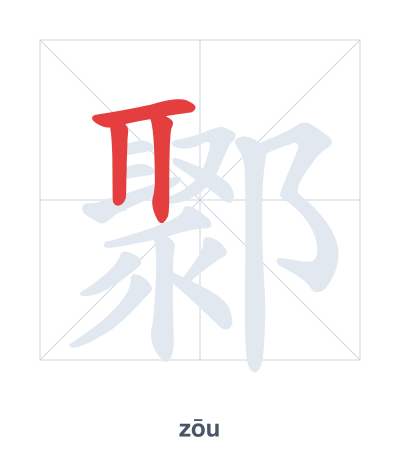
Stroke order practice for 鄹 - zōu

Practice Writing 鄹 (zōu)

Open Hanzi Writer to see the animated stroke order and practice writing 鄹 with real-time feedback.

The character (zōu) is written with 16 strokes. Follow the standard Chinese stroke order: top to bottom, left to right, outside before inside. The radical is one of its key components.

Practice the correct stroke order with the Hanzi Writer app to see animated stroke-by-stroke guidance with real-time feedback.

means Zou (an ancient place name).

Character
Pinyinzōu (zou)
MeaningZou (an ancient place name)
Strokes16
Radical
Difficulty3.9/5

鄹 is a compound of 阝 (city mound) and 聚 (to gather). It refers to an ancient city in present-day Shandong that served as a gathering place, hence the place name Zou.

💡 Memory Tip: At the city of Zou (鄹), people gather (聚) to take (取) a pig (彐) to the river (水).

zōu yì
Zouyi (ancient name for Confucius's birthplace)
zōu rén
People of Zou
zōu jiàn
Zoujian (an ancient term)

鄹邑是孔子故里。

zōu yì shì kǒng zi gù lǐ

Zouyi is the hometown of Confucius.

鄹人很有礼貌。

zōu rén hěn yǒu lǐ mào

The people of Zou are very polite.

鄹见是古词。

zōu jiàn shì gǔ cí

'Zoujian' is an ancient word.

Character Pinyin Strokes Radical
(current) zōu 16
14
shàn 14
14
Stroke order practice for 鄹 - zōu

Practice Writing 鄹 (zōu)

Open Hanzi Writer to see the animated stroke order and practice writing 鄹 with real-time feedback.

✨ Animated stroke order · Handwriting recognition · HSK-graded practice · Free to use

Frequently Asked Questions about 鄹

The character 鄹 consists of the radical 阝 (city) on the left and 聚 (gather) on the right. The left radical indicates a place or city, and the right part suggests gathering, so together they mean a place where people gather, referring to an ancient location. This matches the historical use of 鄹 as a place name.

Characters with Radical 阝

Other 16-Stroke Characters