鄯 (shàn) means "Shan (used in place names)" in Chinese. It has 14 strokes with the radical 阝.
Rated 3.9/5 in difficulty (challenging).
Appears in 3+ common words including 鄯善 (shàn shàn), 鄯州 (shàn zhōu), 鄯善县 (shàn shàn xiàn).
Due to its 14 strokes, Hanzi Writer's error detection shows 鄯 requires focused practice — most learners need 10+ attempts for consistent accuracy.
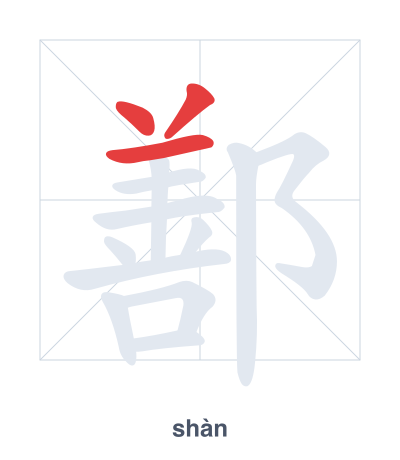
Open Hanzi Writer to see the animated stroke order and practice writing 鄯 with real-time feedback.
The character 鄯 (shàn) is written with 14 strokes. Follow the standard Chinese stroke order: top to bottom, left to right, outside before inside. The radical 阝 is one of its key components.
Practice the correct stroke order with the Hanzi Writer app to see animated stroke-by-stroke guidance with real-time feedback.
鄯 means Shan (used in place names).
This character is a phono-semantic compound combining the radical 阝 (city, state) with the phonetic component 善 (shàn, meaning 'good'), used historically in the place name 鄯善, an ancient kingdom in Central Asia. The radical indicates a settlement or region, while the phonetic provides the sound and a subtle connotation of virtue.
💡 Memory Tip: Picture a peaceful city (阝) where all the virtuous people (善, showing a sheep saying 'good' with its mouth) live together harmoniously.
鄯善在新疆。
shàn shàn zài xīn jiāng
Shanshan is in Xinjiang.
鄯州风景优美。
shàn zhōu fēng jǐng yōu měi
Shanzhou has beautiful scenery.
鄯善县很大。
shàn shàn xiàn hěn dà
Shanshan County is very large.
Open Hanzi Writer to see the animated stroke order and practice writing 鄯 with real-time feedback.
✨ Animated stroke order · Handwriting recognition · HSK-graded practice · Free to use
The character 鄯 is made of the radical 阝 (on the left, meaning "place" or "town") and the right part 善 (shàn, meaning "good" or "kind"). The right part gives the pronunciation, while the radical indicates that 鄯 is used in place names, like a county or prefecture.