鄱 (pó) means "Po (used in place names)" in Chinese. It has 14 strokes with the radical 阝.
Rated 3.9/5 in difficulty (challenging).
Appears in 3+ common words including 鄱阳湖 (pó yáng hú), 鄱阳 (pó yáng), 鄱湖 (pó hú).
Due to its 14 strokes, Hanzi Writer's error detection shows 鄱 requires focused practice — most learners need 10+ attempts for consistent accuracy.
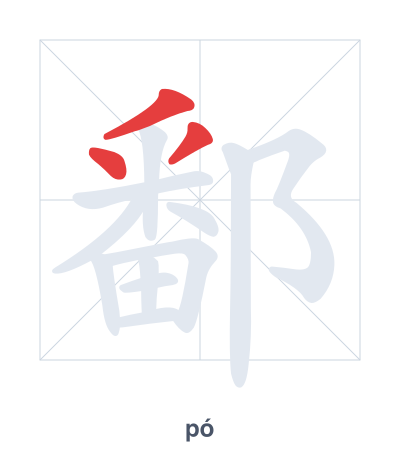
Open Hanzi Writer to see the animated stroke order and practice writing 鄱 with real-time feedback.
The character 鄱 (pó) is written with 14 strokes. Follow the standard Chinese stroke order: top to bottom, left to right, outside before inside. The radical 阝 is one of its key components.
Practice the correct stroke order with the Hanzi Writer app to see animated stroke-by-stroke guidance with real-time feedback.
鄱 means Po (used in place names).
鄱 combines the radical 阝 (meaning 'mound' or 'hill') with the phonetic component 番 (fān), which originally depicted animal footprints on a field. Together, they form a place name, famously referring to Poyang Lake in China.
💡 Memory Tip: Picture a hill (阝) beside a field (田) where a farmer is turning over soil with a pitchfork (the upper part of 番) — that's the scenic spot of Poyang.
鄱阳湖很大。
pó yáng hú hěn dà
Poyang Lake is very large.
他家在鄱阳。
tā jiā zài pó yáng
His family is in Poyang.
鄱湖水产丰富。
pó hú shuǐ chǎn fēng fù
Poyang Lake is rich in aquatic products.
Open Hanzi Writer to see the animated stroke order and practice writing 鄱 with real-time feedback.
✨ Animated stroke order · Handwriting recognition · HSK-graded practice · Free to use
鄱 is composed of two parts: the left side is 番 (fān) and the right side is 阝 (the town radical). The 阝radical indicates that 鄱 is a place name, which matches its use in locations like Poyang Lake. The left side 番 provides the pronunciation clue, as it is pronounced "fān" but here the whole character is read as pó.