鄦 (xǔ) means "Xu (ancient state name)" in Chinese. It has 14 strokes with the radical 阝.
Rated 3.9/5 in difficulty (challenging).
Appears in 3+ common words including 鄦地 (xǔ dì), 鄦国 (xǔ guó), 鄦邑 (xǔ yì).
Due to its 14 strokes, Hanzi Writer's error detection shows 鄦 requires focused practice — most learners need 10+ attempts for consistent accuracy.
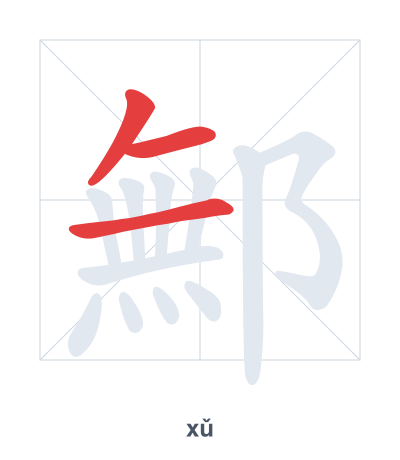
Open Hanzi Writer to see the animated stroke order and practice writing 鄦 with real-time feedback.
The character 鄦 (xǔ) is written with 14 strokes. Follow the standard Chinese stroke order: top to bottom, left to right, outside before inside. The radical 阝 is one of its key components.
Practice the correct stroke order with the Hanzi Writer app to see animated stroke-by-stroke guidance with real-time feedback.
鄦 means Xu (ancient state name).
鄦 is a compound character representing an ancient state name. The left side 阝 (from 阜) indicates a place or settlement, while the right side 無 originally depicted a dancer but here may serve as a phonetic element, though its modern pronunciation 'wú' differs from the character's reading 'xǔ'.
💡 Memory Tip: Imagine a hill (阝) where a dancer (無) named Xu performed to celebrate the founding of the ancient state.
鄦地在河南。
xǔ dì zài hé nán
The region of Xu is in Henan.
鄦国是一个古国。
xǔ guó shì yí gè gǔ guó
The State of Xu was an ancient state.
鄦邑规模很小。
xǔ yì guī mó hěn xiǎo
The town of Xu was very small in scale.
Open Hanzi Writer to see the animated stroke order and practice writing 鄦 with real-time feedback.
✨ Animated stroke order · Handwriting recognition · HSK-graded practice · Free to use
The character 鄦 is made of two parts: the left radical 阝 (meaning a place or state) and the right part 無. The radical 阝 indicates that 鄦 is a location, while 無 provides the sound. Together they refer to the ancient State of Xu, a historical territory.