踪 (zōng) means "trace; track; footprint" in Chinese. It has 15 strokes with the radical 足, and is HSK Level 7.
Rated 4.2/5 in difficulty (advanced).
Harder than 91% of HSK Level 7 characters.
Appears in 3+ common words including 失踪 (shī zōng), 跟踪 (gēn zōng), 踪影 (zōng yǐng).
Due to its 15 strokes, Hanzi Writer's error detection shows 踪 requires focused practice — most learners need 10+ attempts for consistent accuracy.
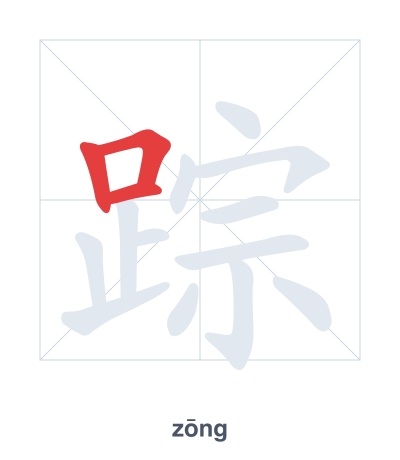
Open Hanzi Writer to see the animated stroke order and practice writing 踪 with real-time feedback.
The character 踪 (zōng) is written with 15 strokes. Follow the standard Chinese stroke order: top to bottom, left to right, outside before inside. The radical 足 is one of its key components.
Practice the correct stroke order with the Hanzi Writer app to see animated stroke-by-stroke guidance with real-time feedback.
踪 means trace; track; footprint.
As an HSK Level 7 character, 踪 is an intermediate-level character.
踪 combines the radical 足 (foot) with the phonetic component 宗 (ancestor). The foot radical indicates the character relates to footsteps or tracks, while 宗 suggests following a lineage or path, together conveying the idea of a trail left by ancestors or travelers.
💡 Memory Tip: Imagine a pair of footprints (足) leading up to an ancestral temple (宗), showing the trace of your family's path through history.
他的猫失踪了。
tā de māo shī zōng le
His cat is missing.
别跟踪我。
bié gēn zōng wǒ
Don't follow me.
他不见了踪影。
tā bú jiàn le zōng yǐng
He disappeared without a trace.
Open Hanzi Writer to see the animated stroke order and practice writing 踪 with real-time feedback.
✨ Animated stroke order · Handwriting recognition · HSK-graded practice · Free to use
The character 踪 is made of the radical 足 (foot) on the left and the phonetic component 宗 (zōng, ancestor) on the right. The foot radical suggests actions related to walking or movement, while 宗 gives the sound and hints at following a path, like tracking an ancestor's trail. Together, they form the idea of a trace or footprint left behind.