追 (zhuī) means "To chase; to pursue" in Chinese. It has 9 strokes with the radical 辶, and is HSK Level 3.
Rated 4/5 in difficulty (challenging).
Harder than 69% of HSK Level 3 characters.
Appears in 3+ common words including 追求 (zhuī qiú), 追赶 (zhuī gǎn), 追问 (zhuī wèn).
Due to its 9 strokes, Hanzi Writer's error detection shows 追 requires focused practice — most learners need 10+ attempts for consistent accuracy.
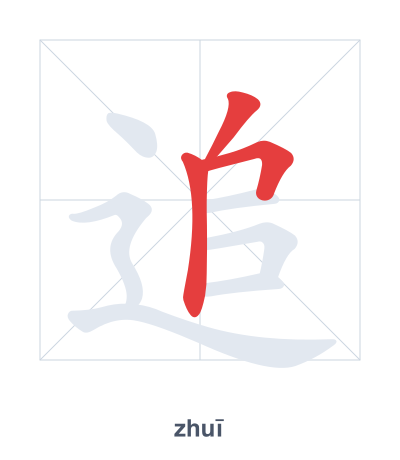
Open Hanzi Writer to see the animated stroke order and practice writing 追 with real-time feedback.
The character 追 (zhuī) is written with 9 strokes. Follow the standard Chinese stroke order: top to bottom, left to right, outside before inside. The radical 辶 is one of its key components.
Practice the correct stroke order with the Hanzi Writer app to see animated stroke-by-stroke guidance with real-time feedback.
追 means To chase; to pursue.
As an HSK Level 3 character, 追 is an intermediate-level character.
追 combines the walking radical 辶 with the component 㠯, which originally depicted a person or a self. The character visually shows a person moving (辶) to pursue another figure (㠯), hence 'to chase'.
💡 Memory Tip: Imagine the right side 㠯 as a person's head and shoulders running ahead, and the left 辶 as your own footsteps following closely in pursuit.
每个人都追求幸福。
měi gè rén dōu zhuī qiú xìng fú
Everyone pursues happiness.
孩子在草地上追赶蝴蝶。
hái zi zài cǎo dì shàng zhuī gǎn hú dié
The child is chasing butterflies on the grass.
妈妈不停地追问细节。
mā mā bù tíng dì zhuī wèn xì jié
Mom kept asking for details.
Open Hanzi Writer to see the animated stroke order and practice writing 追 with real-time feedback.
✨ Animated stroke order · Handwriting recognition · HSK-graded practice · Free to use
The character 追 consists of the radical 辶 (walking or movement) on the left, and a phonetic component 自 (zì, self) on the upper right combined with 廾 (hands) at the bottom. The 辶 radical indicates motion, while the right part originally suggested following one's own steps, together conveying the idea of chasing or pursuing something.