赚 (zhuàn) means "to earn; to make a profit" in Chinese. It has 14 strokes with the radical 贝, and is HSK Level 6.
Rated 4.2/5 in difficulty (advanced).
Harder than 90% of HSK Level 6 characters.
Appears in 3+ common words including 赚钱 (zhuàn qián), 赚了 (zhuàn le), 赚到 (zhuàn dào).
Due to its 14 strokes, Hanzi Writer's error detection shows 赚 requires focused practice — most learners need 10+ attempts for consistent accuracy.
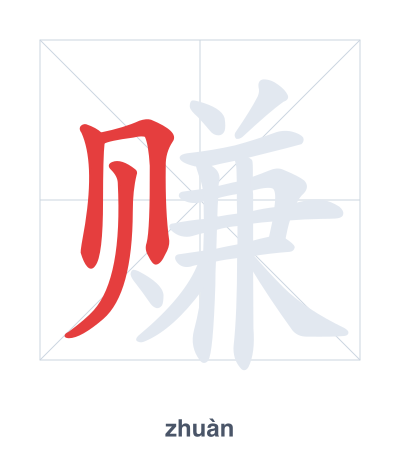
Open Hanzi Writer to see the animated stroke order and practice writing 赚 with real-time feedback.
The character 赚 (zhuàn) is written with 14 strokes. Follow the standard Chinese stroke order: top to bottom, left to right, outside before inside. The radical 贝 is one of its key components.
Practice the correct stroke order with the Hanzi Writer app to see animated stroke-by-stroke guidance with real-time feedback.
赚 means to earn; to make a profit.
As an HSK Level 6 character, 赚 is an intermediate-level character.
赚 is a compound character. The left radical 贝 (shell) represents money or valuables, as shells were used as currency in ancient China. The right component 兼 originally meant 'to combine' or 'double,' and together they suggest 'doubling one's money'—making a profit by combining resources or increasing wealth.
💡 Memory Tip: Picture a shell (贝) splitting into two identical halves (兼) to double its value—that's earning a profit.
他想多赚钱。
tā xiǎng duō zhuàn qián
He wants to earn more money.
这次生意赚了。
zhè cì shēng yì zhuàn le
This business deal was profitable.
我赚到了经验。
wǒ zhuàn dào le jīng yàn
I gained experience.
Open Hanzi Writer to see the animated stroke order and practice writing 赚 with real-time feedback.
✨ Animated stroke order · Handwriting recognition · HSK-graded practice · Free to use
The left side is 贝, meaning 'shell' or 'money,' and the right side is 兼, meaning 'double' or 'combined.' Together, they suggest combining money or resources to earn a profit. So 赚 visually represents using money to make more money.