赌 (dǔ) means "to gamble; to bet" in Chinese. It has 12 strokes with the radical 贝, and is HSK Level 6.
Rated 4.2/5 in difficulty (advanced).
Harder than 90% of HSK Level 6 characters.
Appears in 3+ common words including 打赌 (dǎ dǔ), 赌博 (dǔ bó), 赌气 (dǔ qì).
Due to its 12 strokes, Hanzi Writer's error detection shows 赌 requires focused practice — most learners need 10+ attempts for consistent accuracy.
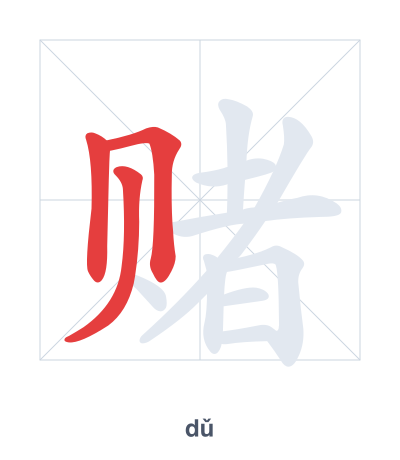
Open Hanzi Writer to see the animated stroke order and practice writing 赌 with real-time feedback.
The character 赌 (dǔ) is written with 12 strokes. Follow the standard Chinese stroke order: top to bottom, left to right, outside before inside. The radical 贝 is one of its key components.
Practice the correct stroke order with the Hanzi Writer app to see animated stroke-by-stroke guidance with real-time feedback.
赌 means to gamble; to bet.
As an HSK Level 6 character, 赌 is an intermediate-level character.
The character 赌 combines the radical 贝 (shell, representing money) with the phonetic component 者 (originally depicting a person or a cooking pot). Together, they convey the idea of a person putting money at risk, which is the essence of gambling or betting.
💡 Memory Tip: Picture a person (者) tossing a shell (贝) onto a gambling table, betting it all on a risky roll of the dice.
我们打赌谁会赢。
wǒ men dǎ dǔ shuí huì yíng
We are betting on who will win.
赌博是不好的习惯。
dǔ bó shì bù hǎo de xí guàn
Gambling is a bad habit.
别跟他赌气了。
bié gēn tā dǔ qì le
Stop acting out of spite against him.
Open Hanzi Writer to see the animated stroke order and practice writing 赌 with real-time feedback.
✨ Animated stroke order · Handwriting recognition · HSK-graded practice · Free to use
赌 has two parts: the left radical 贝 (shell, representing money) and the right part 者 (a person or doer). The meaning 'to gamble' comes from the idea of a person using money in a risky bet, as gambling always involves money or valuable items.