赋 (fù) means "to give; tax; poetic essay" in Chinese. It has 12 strokes with the radical 贝, and is HSK Level 7.
Rated 4.2/5 in difficulty (advanced).
Harder than 90% of HSK Level 7 characters.
Appears in 3+ common words including 天赋 (tiān fù), 赋予 (fù yǔ), 赋税 (fù shuì).
Due to its 12 strokes, Hanzi Writer's error detection shows 赋 requires focused practice — most learners need 10+ attempts for consistent accuracy.
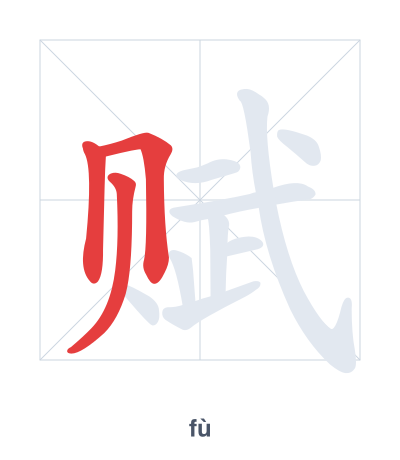
Open Hanzi Writer to see the animated stroke order and practice writing 赋 with real-time feedback.
The character 赋 (fù) is written with 12 strokes. Follow the standard Chinese stroke order: top to bottom, left to right, outside before inside. The radical 贝 is one of its key components.
Practice the correct stroke order with the Hanzi Writer app to see animated stroke-by-stroke guidance with real-time feedback.
赋 means to give; tax; poetic essay.
As an HSK Level 7 character, 赋 is an intermediate-level character.
Combines the radical 贝 (shell, money) with 武 (military), originally referring to taxes collected to support armies. Later extended to mean 'to give' in a broader sense, and also a poetic essay (as a form of tribute or recitation).
💡 Memory Tip: Picture a warrior (武) handing over shells (贝) as tax, then dramatically reciting a poem about the transaction.
他很有音乐天赋。
tā hěn yǒu yīn yuè tiān fù
He has a talent for music.
法律赋予我们权利。
fǎ lǜ fù yǔ wǒ men quán lì
The law grants us rights.
古代的赋税很重。
gǔ dài de fù shuì hěn zhòng
Ancient taxes were very heavy.
Open Hanzi Writer to see the animated stroke order and practice writing 赋 with real-time feedback.
✨ Animated stroke order · Handwriting recognition · HSK-graded practice · Free to use
赋 has two parts: the left radical 贝 (shell/money) and the right component 武 (military). The 贝 shows a connection to wealth or value, while the right side originally suggests an action like imposing or giving, so together they relate to giving money as tax or bestowing gifts.