煮 (zhǔ) means "to boil; to cook" in Chinese. It has 12 strokes with the radical 灬, and is HSK Level 6.
Rated 4.2/5 in difficulty (advanced).
Harder than 76% of HSK Level 6 characters.
Appears in 3+ common words including 煮饭 (zhǔ fàn), 煮面 (zhǔ miàn), 煮鸡蛋 (zhǔ jī dàn).
Due to its 12 strokes, Hanzi Writer's error detection shows 煮 requires focused practice — most learners need 10+ attempts for consistent accuracy.
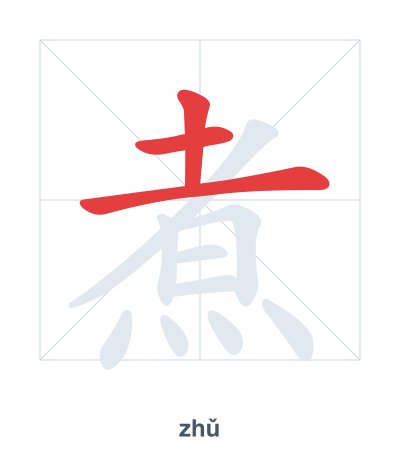
Open Hanzi Writer to see the animated stroke order and practice writing 煮 with real-time feedback.
The character 煮 (zhǔ) is written with 12 strokes. Follow the standard Chinese stroke order: top to bottom, left to right, outside before inside. The radical 灬 is one of its key components.
Practice the correct stroke order with the Hanzi Writer app to see animated stroke-by-stroke guidance with real-time feedback.
煮 means to boil; to cook.
As an HSK Level 6 character, 煮 is an intermediate-level character.
煮 combines 者 (zhě, here acting as a phonetic component) with the fire radical 灬, which indicates the meaning of cooking or boiling with heat. The character visually represents something being placed over fire to cook.
💡 Memory Tip: Imagine a person (者) sitting by a fire (灬) stirring a pot of boiling soup.
我每天自己煮饭。
wǒ měi tiān zì jǐ zhǔ fàn
I cook for myself every day.
晚饭我们煮面吃。
wǎn fàn wǒ men zhǔ miàn chī
We are cooking noodles for dinner.
煮鸡蛋很有营养。
zhǔ jī dàn hěn yǒu yíng yǎng
Boiled eggs are very nutritious.
Open Hanzi Writer to see the animated stroke order and practice writing 煮 with real-time feedback.
✨ Animated stroke order · Handwriting recognition · HSK-graded practice · Free to use
煮 is composed of two parts: the top part 者 (zhě, 'person') and the bottom radical 灬 (huǒ, 'fire'). The fire radical indicates that the character involves heating or cooking, while 者 gives the sound and suggests the action is done by a person. Together, they show a person using fire to boil or cook food.