粥 (zhōu) means "porridge; congee" in Chinese. It has 12 strokes with the radical 米, and is HSK Level 6.
Rated 4.2/5 in difficulty (advanced).
Harder than 83% of HSK Level 6 characters.
Appears in 3+ common words including 喝粥 (hē zhōu), 煮粥 (zhǔ zhōu), 大米粥 (dà mǐ zhōu).
Due to its 12 strokes, Hanzi Writer's error detection shows 粥 requires focused practice — most learners need 10+ attempts for consistent accuracy.
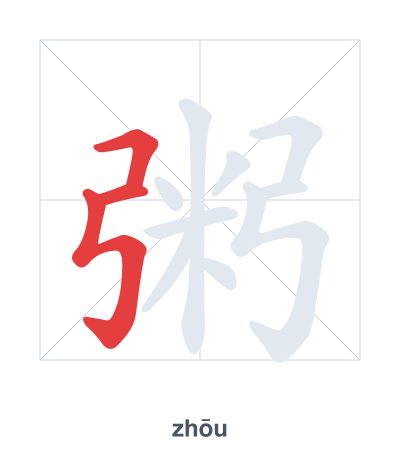
Open Hanzi Writer to see the animated stroke order and practice writing 粥 with real-time feedback.
The character 粥 (zhōu) is written with 12 strokes. Follow the standard Chinese stroke order: top to bottom, left to right, outside before inside. The radical 米 is one of its key components.
Practice the correct stroke order with the Hanzi Writer app to see animated stroke-by-stroke guidance with real-time feedback.
粥 means porridge; congee.
As an HSK Level 6 character, 粥 is an intermediate-level character.
粥 combines the radical 米 (rice) with two 弓 (bow) shapes that originally depicted steam rising from a cooking pot. In ancient scripts, the top part represented a vessel with steam, and the rice below indicates the main ingredient of porridge.
💡 Memory Tip: Imagine two bent bows (弓) hanging over a bowl of rice (米) as you stir it into a thick, steaming porridge.
生病时喝粥比较舒服。
shēng bìng shí hē zhōu bǐ jiào shū fú
It is more comfortable to eat porridge when sick.
妈妈正在厨房里煮粥。
mā mā zhèng zài chú fáng lǐ zhǔ zhōu
Mom is cooking porridge in the kitchen.
我每天早上喝大米粥。
wǒ měi tiān zǎo shàng hē dà mǐ zhōu
I have rice porridge every morning.
Open Hanzi Writer to see the animated stroke order and practice writing 粥 with real-time feedback.
✨ Animated stroke order · Handwriting recognition · HSK-graded practice · Free to use
粥 is made of three parts: the left side 米 (rice) shows the main ingredient, the top right 弓 (bow) and bottom right 米 again. The two 米 components emphasize that porridge is made from cooked rice, while the 弓 in the middle suggests the stirring motion needed to make it smooth.