辙 (zhé) means "Track; rut; rhyme." in Chinese. It has 16 strokes with the radical 车, and is HSK Level 7.
Rated 4.2/5 in difficulty (advanced).
Harder than 92% of HSK Level 7 characters.
Appears in 3+ common words including 没辙 (méi zhé), 找辙 (zhǎo zhé), 覆辙 (fù zhé).
Due to its 16 strokes, Hanzi Writer's error detection shows 辙 requires focused practice — most learners need 10+ attempts for consistent accuracy.
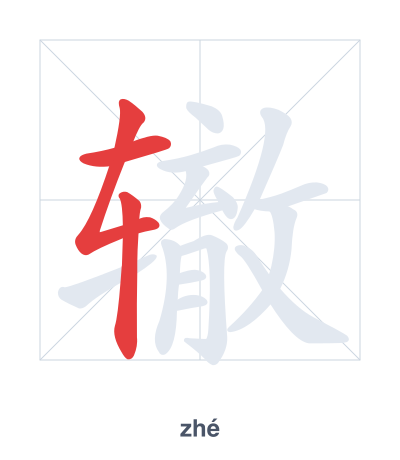
Open Hanzi Writer to see the animated stroke order and practice writing 辙 with real-time feedback.
The character 辙 (zhé) is written with 16 strokes. Follow the standard Chinese stroke order: top to bottom, left to right, outside before inside. The radical 车 is one of its key components.
Practice the correct stroke order with the Hanzi Writer app to see animated stroke-by-stroke guidance with real-time feedback.
辙 means Track; rut; rhyme..
As an HSK Level 7 character, 辙 is an intermediate-level character.
辙 is a phono-semantic compound: the left side 车 (vehicle) indicates the meaning of wheel tracks or ruts, while the right side 㪿 (a variant of 折, meaning 'to break' or 'to bend') provides the pronunciation zhé and hints at the idea of ground being broken or bent by a vehicle's passage.
💡 Memory Tip: Picture a vehicle (车) breaking (折) the earth to create a deep rut or track on the road.
我真拿他没辙。
wǒ zhēn ná tā méi zhé
I really don't know what to do with him.
别再找辙了。
bié zài zhǎo zhé le
Stop making excuses.
别重蹈覆辙。
bié chóng dǎo fù zhé
Don't repeat the same mistake.
Open Hanzi Writer to see the animated stroke order and practice writing 辙 with real-time feedback.
✨ Animated stroke order · Handwriting recognition · HSK-graded practice · Free to use
The left component is 车 (vehicle), which hints at wheels or transportation. The right component is 徹 (to clear or penetrate), which together with 车 suggests the track or rut left by a vehicle's wheels. This structure directly connects to the character's meaning of 'track' or 'rut'.