辕 (yuán) means "Shaft (of a cart or carriage)." in Chinese. It has 14 strokes with the radical 车.
Rated 4.2/5 in difficulty (advanced).
Appears in 3+ common words including 辕门 (yuán mén), 辕马 (yuán mǎ), 辕条 (yuán tiáo).
Due to its 14 strokes, Hanzi Writer's error detection shows 辕 requires focused practice — most learners need 10+ attempts for consistent accuracy.
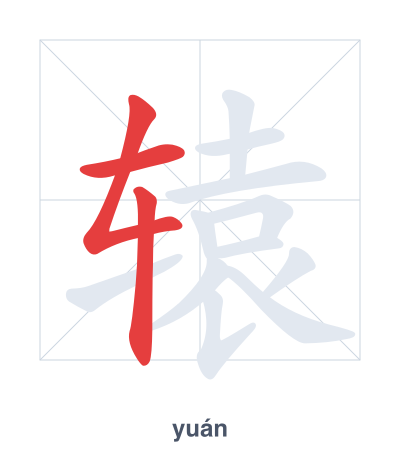
Open Hanzi Writer to see the animated stroke order and practice writing 辕 with real-time feedback.
The character 辕 (yuán) is written with 14 strokes. Follow the standard Chinese stroke order: top to bottom, left to right, outside before inside. The radical 车 is one of its key components.
Practice the correct stroke order with the Hanzi Writer app to see animated stroke-by-stroke guidance with real-time feedback.
辕 means Shaft (of a cart or carriage)..
辕 is a phono-semantic compound: the radical 车 (carriage) indicates the meaning, and the component 袁 (yuán) provides the pronunciation. 袁 originally depicted a long garment, hinting at the elongated shape of the cart shaft, which is the long pole connecting the carriage to the horse.
💡 Memory Tip: Imagine a cart (车) with a long shaft shaped like a winding robe (the right side 袁) stretching forward to the horse.
他走进了辕门。
tā zǒu jìn le yuán mén
He entered the gate of the military camp.
辕马在拉重物。
yuán mǎ zài lā zhòng wù
The shaft horse is pulling a heavy load.
辕条需要修理。
yuán tiáo xū yào xiū lǐ
The shafts need to be repaired.
Open Hanzi Writer to see the animated stroke order and practice writing 辕 with real-time feedback.
✨ Animated stroke order · Handwriting recognition · HSK-graded practice · Free to use
辕 is composed of the radical 车 (vehicle) on the left and the phonetic component 袁 on the right. The radical 车 directly indicates that the character relates to a cart or carriage, while 袁 provides the pronunciation yuán. Together, they form the meaning 'shaft of a cart'.