毂 (gǔ) means "The hub of a wheel." in Chinese. It has 13 strokes with the radical 车.
Rated 3.9/5 in difficulty (challenging).
Appears in 3+ common words including 轮毂 (lún gǔ), 车毂 (chē gǔ), 毂下 (gǔ xià).
Due to its 13 strokes, Hanzi Writer's error detection shows 毂 requires focused practice — most learners need 10+ attempts for consistent accuracy.
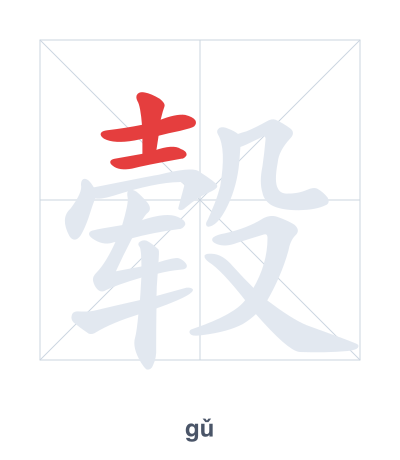
Open Hanzi Writer to see the animated stroke order and practice writing 毂 with real-time feedback.
The character 毂 (gǔ) is written with 13 strokes. Follow the standard Chinese stroke order: top to bottom, left to right, outside before inside. The radical 车 is one of its key components.
Practice the correct stroke order with the Hanzi Writer app to see animated stroke-by-stroke guidance with real-time feedback.
毂 means The hub of a wheel..
The character 毂 is a compound: the left part 车 represents a cart or wheel, while the right part originally depicted a wheel hub with spokes and an axle. Together, they signify the central hub of a wheel where the axle fits.
💡 Memory Tip: Imagine a cart (车) whose wheel hub is being hammered tight by a hand holding a mallet (殳) to keep the axle secure.
这个轮毂需要更换。
zhè ge lún gǔ xū yào gēng huàn
This wheel hub needs to be replaced.
车毂是车轮的一部分。
chē gǔ shì chē lún de yī bù fèn
The hub is a part of the wheel.
他来到了毂下生活。
tā lái dào le gǔ xià shēng huó
He came to live in the capital.
Open Hanzi Writer to see the animated stroke order and practice writing 毂 with real-time feedback.
✨ Animated stroke order · Handwriting recognition · HSK-graded practice · Free to use
The character 毂 has the radical 车 (vehicle) on the left, which links it to wheels and vehicles. The right part is a phonetic component that also visually suggests the shape of a wheel hub with spokes, reinforcing the meaning of "hub of a wheel."