轘 (huán) means "ancient punishment of tearing apart by chariots" in Chinese. It has 20 strokes with the radical 车.
Rated 3.8/5 in difficulty (challenging).
Appears in 3+ common words including 轘裂 (huán liè), 轘刑 (huán xíng), 轘辕 (huán yuán).
Due to its 20 strokes, Hanzi Writer's error detection shows 轘 requires focused practice — most learners need 10+ attempts for consistent accuracy.
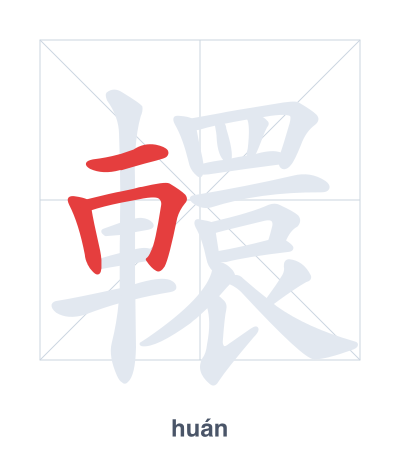
Open Hanzi Writer to see the animated stroke order and practice writing 轘 with real-time feedback.
The character 轘 (huán) is written with 20 strokes. Follow the standard Chinese stroke order: top to bottom, left to right, outside before inside. The radical 车 is one of its key components.
Practice the correct stroke order with the Hanzi Writer app to see animated stroke-by-stroke guidance with real-time feedback.
轘 means ancient punishment of tearing apart by chariots.
轘 is a semantic-phonetic compound: the radical 车 (chariot) directly indicates the means of execution—tearing apart by chariots—while the phonetic component 睘 (huán) suggests the pronunciation. The character visually places the chariot radical on the left, linking the form to the brutal punishment.
💡 Memory Tip: Imagine a chariot (车) encircled by a ring (睘 like a loop) ripping a body in opposite directions—轘 is the chariot that tears you apart.
东西被轘裂了。
dōng xī bèi huán liè le
The thing was torn apart.
古代有轘刑。
gǔ dài yǒu huán xíng
There was the punishment of dismemberment by chariots in ancient times.
轘辕是地名。
huán yuán shì dì míng
Huanyuan is a place name.
Open Hanzi Writer to see the animated stroke order and practice writing 轘 with real-time feedback.
✨ Animated stroke order · Handwriting recognition · HSK-graded practice · Free to use
轘 is a left-right character: the left side is 车 (chariot) and the right side is 睘 (which provides the pronunciation huán). The chariot radical directly connects to the meaning of the punishment, which was carried out using chariots to tear a person apart.