瘵 (zhài) means "wasting disease or tuberculosis" in Chinese. It has 16 strokes with the radical 疒.
Rated 4.2/5 in difficulty (advanced).
Appears in 3+ common words including 痨瘵 (láo zhài), 瘵疾 (zhài jí), 瘵客 (zhài kè).
Due to its 16 strokes, Hanzi Writer's error detection shows 瘵 requires focused practice — most learners need 10+ attempts for consistent accuracy.
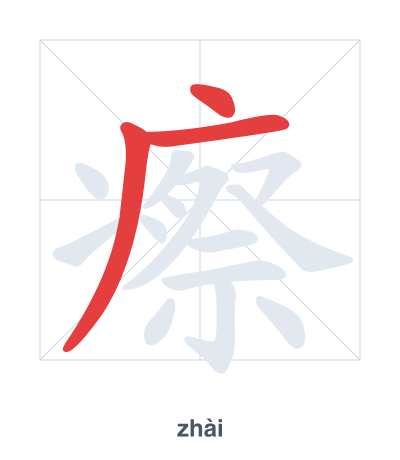
Open Hanzi Writer to see the animated stroke order and practice writing 瘵 with real-time feedback.
The character 瘵 (zhài) is written with 16 strokes. Follow the standard Chinese stroke order: top to bottom, left to right, outside before inside. The radical 疒 is one of its key components.
Practice the correct stroke order with the Hanzi Writer app to see animated stroke-by-stroke guidance with real-time feedback.
瘵 means wasting disease or tuberculosis.
The character 瘵 combines the illness radical 疒 with 祭 (sacrifice), suggesting a wasting disease that consumes the body as if being offered up. In ancient China, tuberculosis was often seen as a slow, sacrificial depletion of life.
💡 Memory Tip: Picture a sick person on a bed (疒) turning into a skeletal sacrifice (祭) as tuberculosis eats away their flesh.
他患有痨瘵多年。
tā huàn yǒu láo zhài duō nián
He has suffered from tuberculosis for many years.
这种瘵疾很严重。
zhè zhǒng zhài jí hěn yán zhòng
This chronic wasting disease is very serious.
那个瘵客一直在咳嗽。
nà ge zhài kè yì zhí zài ké sòu
That tuberculosis patient has been coughing continuously.
Open Hanzi Writer to see the animated stroke order and practice writing 瘵 with real-time feedback.
✨ Animated stroke order · Handwriting recognition · HSK-graded practice · Free to use
瘵 is made of the radical 疒 on the left, meaning 'illness,' and the component 祭 on the right, which provides the sound zhài. Together, 疒 indicates a disease, and 祭 (originally 'sacrifice') hints at severe, debilitating illness like a wasting disease that consumes the body.