谮 (zèn) means "to slander; to calumniate" in Chinese. It has 14 strokes with the radical 讠.
Rated 3.9/5 in difficulty (challenging).
Appears in 3+ common words including 谮言 (zèn yán), 谗谮 (chán zèn), 诬谮 (wū zèn).
Due to its 14 strokes, Hanzi Writer's error detection shows 谮 requires focused practice — most learners need 10+ attempts for consistent accuracy.
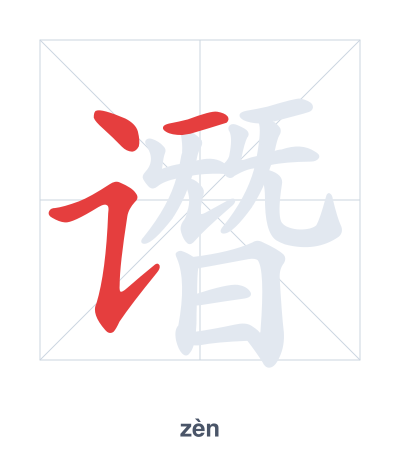
Open Hanzi Writer to see the animated stroke order and practice writing 谮 with real-time feedback.
The character 谮 (zèn) is written with 14 strokes. Follow the standard Chinese stroke order: top to bottom, left to right, outside before inside. The radical 讠 is one of its key components.
Practice the correct stroke order with the Hanzi Writer app to see animated stroke-by-stroke guidance with real-time feedback.
谮 means to slander; to calumniate.
谮 is a phono-semantic compound combining the speech radical 讠 (words) with the phonetic component 朁, which in ancient script depicted a person sinking or hiding. Together they convey the idea of using words to conceal truth and make false accusations—slander.
💡 Memory Tip: Picture a sneaky speaker (讠) zapping someone's reputation with a zigzag lightning bolt (the right side 朁 resembles a bolt and a sun).
不要听信小人的谮言。
bú yào tīng xìn xiǎo rén de zèn yán
Don't listen to the slanders of petty people.
他遭到了别人的谗谮。
tā zāo dào le bié rén de chán zèn
He was slandered by others.
这是对他的诬谮。
zhè shì duì tā de wū zèn
This is a false accusation against him.
Open Hanzi Writer to see the animated stroke order and practice writing 谮 with real-time feedback.
✨ Animated stroke order · Handwriting recognition · HSK-graded practice · Free to use
The left side is the radical 讠, which represents speech or words. The right side is 昝 (zǎn), a phonetic component that also suggests the idea of "piercing" or "penetrating" — together, they form the meaning of using sharp words to attack someone's reputation, i.e., to slander.