谡 (sù) means "to rise; sound of wind" in Chinese. It has 12 strokes with the radical 讠.
Rated 3.9/5 in difficulty (challenging).
Appears in 3+ common words including 马谡 (mǎ sù), 谡谡 (sù sù), 振谡 (zhèn sù).
Due to its 12 strokes, Hanzi Writer's error detection shows 谡 requires focused practice — most learners need 10+ attempts for consistent accuracy.
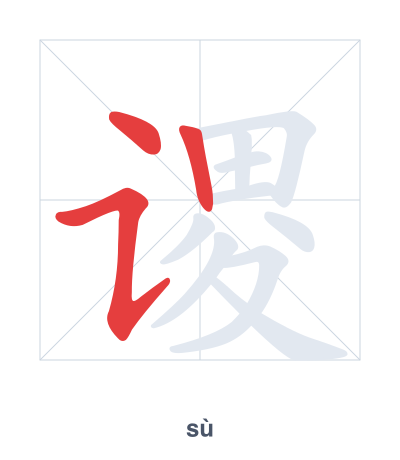
Open Hanzi Writer to see the animated stroke order and practice writing 谡 with real-time feedback.
The character 谡 (sù) is written with 12 strokes. Follow the standard Chinese stroke order: top to bottom, left to right, outside before inside. The radical 讠 is one of its key components.
Practice the correct stroke order with the Hanzi Writer app to see animated stroke-by-stroke guidance with real-time feedback.
谡 means to rise; sound of wind.
This compound character combines the speech radical 讠 with 巺, which serves as a phonetic component suggesting the sound sù. The meaning 'to rise' may evoke words ascending, while 'sound of wind' connects to the rushing quality of the phonetic element.
💡 Memory Tip: Picture a speech bubble (讠) being lifted upward by a gust of wind (巺) that makes a 'swoosh' sound.
马谡很有名。
mǎ sù hěn yǒu míng
Ma Su is very famous.
松风谡谡。
sōng fēng sù sù
The wind soughs through the pines.
精神振谡。
jīng shén zhèn sù
Spirits are invigorated.
Open Hanzi Writer to see the animated stroke order and practice writing 谡 with real-time feedback.
✨ Animated stroke order · Handwriting recognition · HSK-graded practice · Free to use
谡 is composed of the radical 讠 (speech) on the left, which hints that the character is related to language or sound. The right part is 㒸 (suì, though rarely used alone), which contributes the pronunciation sù and adds the idea of movement or rising, matching the meanings "to rise" and "sound of wind."