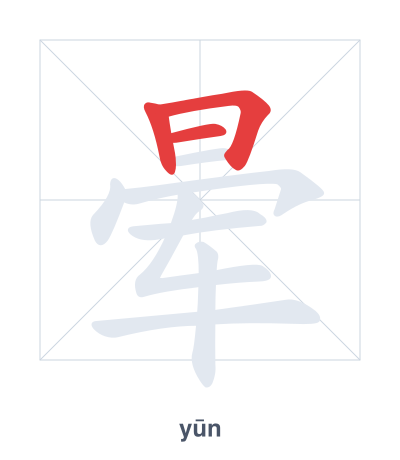
晕 (yūn) means "to feel dizzy; halo" in Chinese. It has 10 strokes with the radical 日, and is HSK Level 6. Difficulty: 4.2/5.
to feel dizzy; halo
The character 晕 (yūn) is written with 10 strokes. Follow the standard Chinese stroke order: top to bottom, left to right, outside before inside. The radical 日 is one of its key components.
Practice the correct stroke order with the Hanzi Writer app to see animated stroke-by-stroke guidance with real-time feedback.
晕 is pronounced yūn in Mandarin Chinese. It means to feel dizzy; halo.
This is a polyphonic character with readings: yūn, yùn.
As an HSK Level 6 character, 晕 is an intermediate-level character.
他因为中暑,突然在路边晕倒了。
tā yīn wèi zhòng shǔ tū rán zài lù biān yūn dǎo le
He suddenly fainted on the roadside due to heatstroke.
感冒让他感到浑身无力,阵阵头晕。
gǎn mào ràng tā gǎn dào hún shēn wú lì zhèn zhèn tóu yūn
The cold made him feel weak all over and gave him bouts of dizziness.
他从小就有晕车的毛病,不敢坐长途车。
tā cóng xiǎo jiù yǒu yùn chē de máo bìng bù gǎn zuò cháng tú chē
He has suffered from motion sickness since childhood and dares not take long-distance buses.
这里的月亮周围有一圈淡淡的光晕。
zhè lǐ de yuè liàng zhōu wéi yǒu yī quān dàn dàn de guāng yùn
There is a faint halo around the moon here.
Open Hanzi Writer to see the animated stroke order and practice writing 晕 with real-time feedback.