早 (zǎo) means "early; morning" in Chinese. It has 6 strokes with the radical 日, and is HSK Level 1.
Rated 2.7/5 in difficulty (moderate).
Harder than 45% of HSK Level 1 characters.
Appears in 3+ common words including 早上 (zǎo shàng), 早餐 (zǎo cān), 早起 (zǎo qǐ).
Hanzi Writer's stroke validation shows learners typically need 5-8 attempts to write 早 with correct proportion and order.
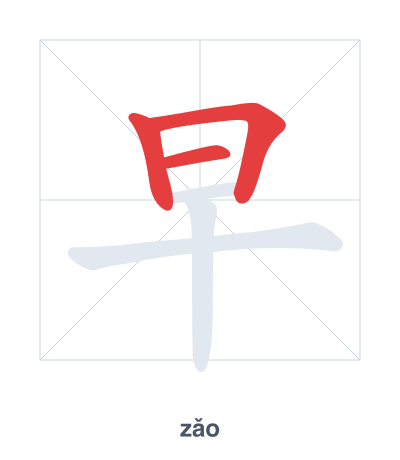
Open Hanzi Writer to see the animated stroke order and practice writing 早 with real-time feedback.
The character 早 (zǎo) is written with 6 strokes. Follow the standard Chinese stroke order: top to bottom, left to right, outside before inside. The radical 日 is one of its key components.
Practice the correct stroke order with the Hanzi Writer app to see animated stroke-by-stroke guidance with real-time feedback.
早 means early; morning.
As an HSK Level 1 character, 早 is among the first characters beginners learn.
早 depicts the sun (日) rising above a horizontal line representing the ground or horizon, indicating the early morning when the sun first appears. Over time, the line evolved into the component 十, but the core idea of dawn remains.
💡 Memory Tip: The sun (日) with a plus sign (+) underneath reminds you to get up early, because adding (+) sunlight to your day starts in the morning.
早上好。
zǎo shàng hǎo
Good morning.
你吃早餐了吗?
nǐ chī zǎo cān le ma
Have you had breakfast?
他每天早起跑步。
tā měi tiān zǎo qǐ pǎo bù
He gets up early every day to go for a run.
Open Hanzi Writer to see the animated stroke order and practice writing 早 with real-time feedback.
✨ Animated stroke order · Handwriting recognition · HSK-graded practice · Free to use
早 is made of 日 (sun) on top and 十 (ten or cross) on bottom. The sun above a horizontal line suggests sunrise, symbolizing early morning.