旮 (gā) means "corner; nook" in Chinese. It has 6 strokes with the radical 日.
Rated 3.2/5 in difficulty (challenging).
Appears in 3+ common words including 旮旯 (gā lá), 墙旮旯 (qiáng gā lá), 山旮旯 (shān gā lá).
Due to its 6 strokes, Hanzi Writer's error detection shows 旮 requires focused practice — most learners need 10+ attempts for consistent accuracy.
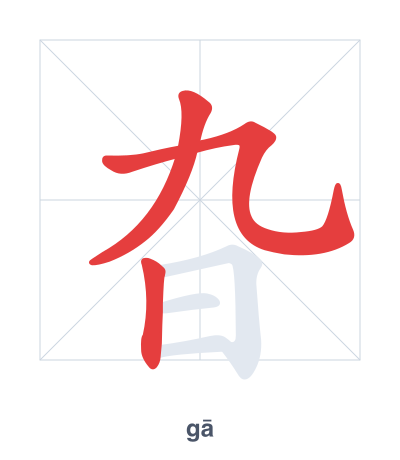
Open Hanzi Writer to see the animated stroke order and practice writing 旮 with real-time feedback.
The character 旮 (gā) is written with 6 strokes. Follow the standard Chinese stroke order: top to bottom, left to right, outside before inside. The radical 日 is one of its key components.
Practice the correct stroke order with the Hanzi Writer app to see animated stroke-by-stroke guidance with real-time feedback.
旮 means corner; nook.
This character combines 九 (nine, suggesting many angles or turns) and 日 (sun, representing light or a place) to depict a nook or corner where light reaches from multiple directions. It is often used in colloquial Chinese for a secluded or tight corner.
💡 Memory Tip: Picture a sun (日) trapped in a cramped corner with nine (九) walls pressing in from all sides.
他躲在旮旯里。
tā duǒ zài gā lá lǐ
He hid in the corner.
墙旮旯里有一盆花。
qiáng gā lá lǐ yǒu yī pén huā
There is a pot of flowers in the corner.
他住在山旮旯里。
tā zhù zài shān gā lá lǐ
He lives in a remote mountain area.
Open Hanzi Writer to see the animated stroke order and practice writing 旮 with real-time feedback.
✨ Animated stroke order · Handwriting recognition · HSK-graded practice · Free to use
旮 is made of two parts: the top is 日 (sun) and the bottom is 九 (nine). Together they suggest a small, hidden corner where only a little sunlight reaches, like a nook. This composition visually implies a tight, out-of-the-way place.